
This document contains 84 Propositional Logic Exercises designed to strengthen and solidify your understanding of this fundamental area of mathematics and philosophy
These exercises complement the following theoretical reference materials:
| # | Theoretical Document | Main Content |
|---|---|---|
| 1 | Logical Propositions | Definition of proposition, logical principles, propositional variables |
| 2 | Logical Connectives | The 6 connectives, truth tables, operator hierarchy |
| 3 | Truth Tables | Table construction, tautologies, contradictions, contingencies |
| 4 | Logical Equivalences | Equivalence laws, expression simplification |
| 5 | Rules of Inference | Modus Ponens, Modus Tollens, syllogisms, reductio ad absurdum |
| 6 | Logic Circuits | Logic gates, circuit design and simplification |
| 7 | Mathematical Proof | Proof methods: direct, contraposition, contradiction, induction |
Learning Goals
This collection provides hands-on practice in:
- Identifying propositions and determining their truth values
- Converting verbal statements into symbolic expressions
- Translating symbolic expressions back into natural language
- Evaluating compound propositions with truth tables
- Proving logical equivalences
- Applying rules of inference to arguments
- Designing and simplifying logic circuits
How This Document Is Organized
The exercises are grouped by topic, with each section beginning with a quick reference summary of the key concepts you’ll need.
Section I: Propositions and Logical Connectives
This section covers propositions and logical connectives, including how to identify propositions, symbolize statements, use connectives, and determine truth values.
Quick Reference Guide
What is a proposition?
A proposition is a declarative sentence that can be true (T) or false (F), but never both.
| Propositions ✓ | Not Propositions ✗ |
|---|---|
| “Washington D.C. is the capital of the USA” (T) | “What time is it?” (question) |
| “2 + 3 = 7” (F) | “Close the door!” (command) |
| “Water boils at 100°C” (T) | “x + 5 = 10” (contains undefined variable) |
What doesn’t count as a proposition: Questions, commands, exclamations, wishes, open sentences (containing undefined variables), and paradoxes.
Fundamental Logical Principles
| Principle | Formula | Meaning |
|---|---|---|
| Identity | p ≡ p | Every proposition is identical to itself |
| Non-Contradiction | \( \mathrm{ ¬(p ∧ ¬p) } \) | A proposition cannot be T and F at the same time |
| Excluded Middle | p ∨ ¬p | Every proposition is T or F; there is no third option |
Propositional Variables
Propositional variables are lowercase letters (p, q, r, s…) that represent complete propositions.
| Variable | Proposition | Value |
|---|---|---|
| p | “5 is an even number” | F |
| q | “Brazil is in South America” | T |
| r | “Water boils at 100°C” | T |
Classification of Propositions
| Type | Description | Example |
|---|---|---|
| Simple (Atomic) | Contains no logical connectives | “Mary studies medicine” |
| Compound (Molecular) | Contains one or more connectives | “It rains and it’s cold” |
The 6 Logical Connectives
| Connective | Symbol | Example | When is T |
|---|---|---|---|
| Negation | ¬ | ¬p | Inverts the value of p |
| Conjunction | ∧ | p ∧ q | Only when both are T |
| Disjunction | ∨ | p ∨ q | When at least one is T |
| Conditional | → | p → q | Always, except T→F |
| Biconditional | ↔ | p ↔ q | When both have the same value |
| Exclusive Disjunction | ⊻ | p ⊻ q | When exactly one is T |
Ways to Express Connectives
| Connective | Indicator Words/Phrases |
|---|---|
| Negation (¬) | not, it is not true that, it is false that, it is not the case that |
| Conjunction (∧) | and, but, moreover, however, although, while, despite |
| Disjunction (∨) | or, either…or |
| Conditional (→) | if…then, whenever, when, only if, implies, is sufficient for, is necessary for |
| Biconditional (↔) | if and only if, when and only when, is equivalent to, is necessary and sufficient |
| Exclusive Disjunction (⊻) | either…or (but not both), exclusively |
Propositions Derived from the Conditional
From a conditional p → q, the following can be formed:
| Name | Form | Example: “If it rains, then the street gets wet” |
|---|---|---|
| Direct | p → q | If it rains, then the street gets wet |
| Converse | q → p | If the street gets wet, then it rains |
| Inverse | \( \mathrm{ ¬p → ¬q } \) | If it doesn’t rain, then the street doesn’t get wet |
| Contrapositive | ¬q → ¬p | If the street doesn’t get wet, then it doesn’t rain |
Important: The direct and contrapositive always have the same truth value. The converse and inverse also have the same value as each other.
Operator Hierarchy (Order of Precedence)
| Priority | Operator | Symbol |
|---|---|---|
| 1 (highest) | Parentheses | ( ) |
| 2 | Negation | ¬ |
| 3 | Conjunction | ∧ |
| 4 | Disjunction | ∨ |
| 5 | Conditional | → |
| 6 (lowest) | Biconditional | ↔ |
Example: p ∨ q ∧ r is equivalent to p ∨ (q ∧ r), because ∧ has higher precedence than ∨.
Summary Truth Tables
Negation (¬p)
| p | ¬p |
|---|---|
| T | F |
| F | T |
Conjunction (p ∧ q) → Only T when both are T
| p | q | p ∧ q |
|---|---|---|
| T | T | T |
| T | F | F |
| F | T | F |
| F | F | F |
Disjunction (p ∨ q) → Only F when both are F
| p | q | p ∨ q |
|---|---|---|
| T | T | T |
| T | F | T |
| F | T | T |
| F | F | F |
Conditional (p → q) → Only F when T→F
| p | q | p → q |
|---|---|---|
| T | T | T |
| T | F | F |
| F | T | T |
| F | F | T |
Biconditional (p ↔ q) → T when both have the same value
| p | q | p ↔ q |
|---|---|---|
| T | T | T |
| T | F | F |
| F | T | F |
| F | F | T |
Exclusive Disjunction (p ⊻ q) → T when exactly one is T
| p | q | p ⊻ q |
|---|---|---|
| T | T | F |
| T | F | T |
| F | T | T |
| F | F | F |
Finding Truth Values: Step by Step
- Identify the simple propositions (p, q, r…)
- Assign truth values to each one
- Look up the result in the appropriate truth table
- Work from the inside out, respecting parentheses and operator precedence
Worked Examples
Exercise 1
Express each statement in symbolic form:
a) “If it’s cold, then it rains”
Let p: “It’s cold” and q: “It rains”
Solution
- The key words “If… then” signal a Conditional (→)
- Symbolic form: p → q
Note: Symbolic form captures the logical structure, not whether the statement is actually true.
b) “If I study, then I pass the exam, and if I pass the exam, then I go to the party”
Let p: “I study”, q: “I pass the exam” and r: “I go to the party”
Solution
- Breaking it down:
- “If I study, then I pass” → p → q
- “If I pass, then I go to the party” → q → r
- These are connected by “and” → Conjunction (∧)
- Symbolic form: (p → q) ∧ (q → r)
Note: This is the hypothetical syllogism pattern, which lets us conclude p → r.
c) “It is not true that I saw the movie and read the novel”
Let p: “I saw the movie” and q: “I read the novel”
Solution
- Breaking down the structure:
- “It is not true that…” → Negation (¬) applies to everything after
- “saw the movie and read the novel” → Conjunction (p ∧ q)
- Symbolic form: ¬(p ∧ q)
Note: By De Morgan’s Law, this is equivalent to: ¬p ∨ ¬q
d) “If you weren’t crazy, you wouldn’t have come here”
Let p: “You are crazy” and q: “You came here”
Solution
- Looking at the structure:
- “If you were not crazy” → Antecedent: ¬p
- “you would not have come here” → Consequent: ¬q
- Symbolic form: ¬p → ¬q
Note: This is the inverse of a conditional. The inverse is NOT logically equivalent to the original, but it IS equivalent to the converse (q → p).
e) “It rains and either it snows or the wind blows”
Let p: “It rains”, q: “It snows” and r: “The wind blows”
Solution
- We identify the structure:
- “It rains” → p
- “either it snows or the wind blows” → Disjunction: q ∨ r
- “It rains and (either…)” → Conjunction
- Formalization: p ∧ (q ∨ r)
Note: Parentheses matter here. Without them, operator precedence would give us (p ∧ q) ∨ r instead.
f) “Either it’s raining and snowing or the wind is blowing”
Let p: “It’s raining”, q: “It’s snowing” and r: “The wind is blowing”
Solution
- We identify the structure:
- “it’s raining and snowing” → Conjunction: p ∧ q
- “Either (the above) or the wind is blowing” → Disjunction with r
- Formalization: (p ∧ q) ∨ r
Note: Compare this with part (e): p ∧ (q ∨ r) ≠ (p ∧ q) ∨ r. Grouping changes the meaning completely.
g) “If there is true democracy, then there are no arbitrary detentions nor violations of civil rights”
Let p: “There is true democracy”, q: “There are arbitrary detentions” and r: “There are violations of civil rights”
Solution
- We identify the structure:
- “If there is true democracy” → Antecedent: p
- “no detentions nor … violations” → “neither…nor” = Conjunction of negations: ¬q ∧ ¬r
- Formalization: p → (¬q ∧ ¬r)
Note: By De Morgan, ¬q ∧ ¬r = ¬(q ∨ r). Equivalent form: p → ¬(q ∨ r)
Exercise 2
Find the truth value of each proposition:
a) If 5 + 4 = 11, then 6 + 6 = 12
Solution
- The connective is a conditional (→), signaled by “If… then”
- p: “5 + 4 = 11” → Actually 5 + 4 = 9, so p is F
- q: “6 + 6 = 12” → This is correct, so q is T
- From the truth table: F → T = T
Answer: True (T)
b) It is not true that 3 + 3 = 7 if and only if 5 + 5 = 12
Solution
- Structure: negation (¬) of a biconditional (↔)
- p: “3 + 3 = 7” → 3 + 3 = 6, so p is F
- q: “5 + 5 = 12” → 5 + 5 = 10, so q is F
- First we evaluate the biconditional: F ↔ F = T (both have the same value)
- Then we apply negation: ¬T = F
Answer: False (F)
c) Paris is in England or Tokyo is in China.
Solution
- The connective is a disjunction (∨), signaled by “or”
- p: “Paris is in England” → Paris is in France, so p is F
- q: “Tokyo is in China” → Tokyo is in Japan, so q is F
- From the truth table: F ∨ F = F (a disjunction is only false when both parts are false)
Answer: False (F)
d) It is not true that 2 + 2 = 5 or that 3 + 1 = 4
Solution
- Structure: negation (¬) of a disjunction (∨)
- p: “2 + 2 = 5” → 2 + 2 = 4, so p is F
- q: “3 + 1 = 4” → 3 + 1 = 4, so q is T
- First we evaluate the disjunction: F ∨ T = T (at least one is T)
- Then we apply negation: ¬T = F
Answer: False (F)
Exercise 3
Find the truth value of each proposition:
a) 4 + 8 = 12 and 9 – 4 = 5
Solution
- We identify the connective: conjunction (∧) by the word “and”
- p: “4 + 8 = 12” → 4 + 8 = 12, so p is T
- q: “9 – 4 = 5” → 9 – 4 = 5, so q is T
- We apply the conjunction table: T ∧ T = T (conjunction is only T when both are T)
Answer: True (T)
b) 8 + 4 = 12 and 8 – 3 = 2
Solution
- We identify the connective: conjunction (∧) by the word “and”
- p: “8 + 4 = 12” → 8 + 4 = 12, so p is T
- q: “8 – 3 = 2” → 8 – 3 = 5, so q is F
- We apply the conjunction table: T ∧ F = F (if one is F, the conjunction is F)
Answer: False (F)
c) 8 + 4 = 12 or 7 – 2 = 3
Solution
- We identify the connective: disjunction (∨) by the word “or”
- p: “8 + 4 = 12” → 8 + 4 = 12, so p is T
- q: “7 – 2 = 3” → 7 – 2 = 5, so q is F
- We apply the disjunction table: T ∨ F = T (if one is T, the disjunction is T)
Answer: True (T)
d) MIT is in California or is in Massachusetts.
Solution
- The connective is a disjunction (∨), signaled by “or”
- p: “MIT is in California” → MIT is in Massachusetts, so p is F
- q: “MIT is in Massachusetts” → Correct, so q is T
- From the truth table: F ∨ T = T
Answer: True (T)
e) Harvard is in Massachusetts or is in New York.
Solution
- The connective is a disjunction (∨), signaled by “or”
- p: “Harvard is in Massachusetts” → Correct, so p is T
- q: “Harvard is in New York” → so q is F
- From the truth table: T ∨ F = T
Answer: True (T)
f) If 5 + 2 = 7, then 3 + 6 = 9
Solution
- We identify the connective: conditional (→) by “If… then”
- p: “5 + 2 = 7” → 5 + 2 = 7, so p is T
- q: “3 + 6 = 9” → 3 + 6 = 9, so q is T
- We apply the conditional table: T → T = T
Answer: True (T)
g) If 4 + 3 = 2, then 5 + 5 = 10
Solution
- We identify the connective: conditional (→) by “If… then”
- p: “4 + 3 = 2” → 4 + 3 = 7, so p is F
- q: “5 + 5 = 10” → 5 + 5 = 10, so q is T
- We apply the conditional table: F → T = T (conditional is only F when T → F)
Answer: True (T)
h) If 4 + 5 = 9, then 3 + 1 = 2
Solution
- We identify the connective: conditional (→) by “If… then”
- p: “4 + 5 = 9” → 4 + 5 = 9, so p is T
- q: “3 + 1 = 2” → 3 + 1 = 4, so q is F
- We apply the conditional table: T → F = F (this is the only case where the conditional is F)
Answer: False (F)
i) If 7 + 3 = 4, then 11 – 7 = 9
Solution
- We identify the connective: conditional (→) by “If… then”
- p: “7 + 3 = 4” → 7 + 3 = 10, so p is F
- q: “11 – 7 = 9” → 11 – 7 = 4, so q is F
- We apply the conditional table: F → F = T (when the antecedent is F, the conditional is always T)
Answer: True (T)
Exercise 4
For the following statements:
- Pick up that pencil
- 2+5 < 6
- x-y=5
- It’s very cold
Which of the following alternatives is correct?
a) Two are propositions b) Two are open sentences c) Two are neither propositions nor open sentences d) Three are propositions
Solution
Let’s analyze each statement:
| # | Statement | Analysis | Classification |
|---|---|---|---|
| 1 | “Pick up that pencil” | It’s a command/order, has no truth value | ❌ Not a proposition |
| 2 | “2+5 < 6” | It’s a statement: 2+5=7 and 7 < 6 is F | ✅ Proposition (F) |
| 3 | “x-y=5” | Contains undefined variables | ⚠️ Open sentence |
| 4 | “It’s very cold” | It’s subjective/ambiguous, has no defined truth value | ❌ Not a proposition |
Answer: c) Two are neither propositions nor open sentences
(Statements 1 and 4 are neither propositions nor open sentences)
Exercise 5
Given the propositions: p = Mark is a merchant, q = Mark is a prosperous industrialist and r = Mark is an engineer.
Symbolize the statement: “If it is not the case that Mark is a merchant and prosperous industrialist, then he is an engineer or he is not a merchant.”
Solution
Step 1: We identify the simple propositions:
- p: “Mark is a merchant”
- q: “Mark is a prosperous industrialist”
- r: “Mark is an engineer”
Step 2: We decompose the statement into parts:
| Part of the statement | Symbolization |
|---|---|
| “It is not the case that Mark is a merchant and prosperous industrialist” | ¬(p ∧ q) |
| “He is an engineer or he is not a merchant” | r ∨ ¬p |
| “If… then…” | → |
Step 3: We join with the conditional:
\( \neg(p \land q) \rightarrow (r \lor \neg p) \)
Exercise 6
Let p: “It’s cold” and q: “It’s raining”. Write out each symbolic expression in plain English:
| # | Symbolic expression |
|---|---|
| (1) | ¬p |
| (2) | p ∧ q |
| (3) | p ∨ q |
| (4) | q ↔ p |
| (5) | p → ¬q |
| (6) | q ∨ ¬p |
| (7) | ¬p ∧ ¬q |
| (8) | p ↔ ¬q |
| (9) | ¬¬q |
| (10) | (p ∧ ¬q) → p |
Solution
Strategy: Here’s how each symbol translates to English:
| Symbol | Verbal translation |
|---|---|
| ¬ | “not”, “it is not true that”, “it is false that” |
| ∧ | “and” |
| ∨ | “or” |
| → | “if… then” |
| ↔ | “if and only if” |
(1) ¬p
- Structure: Negation of p
- Translation: “It’s not cold”
(2) p ∧ q
- Structure: Conjunction of p and q
- Translation: “It’s cold and it’s raining”
(3) p ∨ q
- Structure: Disjunction of p and q
- Translation: “It’s cold or it’s raining”
(4) q ↔ p
- Structure: Biconditional between q and p
- Translation: “It’s raining if and only if it’s cold”
(5) p → ¬q
- Structure: Conditional with negated consequent
- Translation: “If it’s cold, then it’s not raining”
(6) q ∨ ¬p
- Structure: Disjunction of q and the negation of p
- Translation: “It’s raining or it’s not cold”
(7) ¬p ∧ ¬q
- Structure: Conjunction of two negations
- Translation: “It’s not cold and it’s not raining”
Note: By De Morgan’s Law, this is equivalent to ¬(p ∨ q): “It is not true that it’s cold or it’s raining”
(8) p ↔ ¬q
- Structure: Biconditional between p and the negation of q
- Translation: “It’s cold if and only if it’s not raining”
(9) ¬¬q
- Structure: Double negation of q
- Literal translation: “It is not true that it’s not raining”
- Simplified translation (by double negation): “It’s raining”
Note: By the law of double negation, ¬¬q ≡ q
(10) (p ∧ ¬q) → p
- Structure: Conditional where the antecedent is a conjunction
- Translation: “If it’s cold and it’s not raining, then it’s cold”
Note: This proposition is a tautology (always true), since if “it’s cold” appears in the antecedent, it necessarily holds in the consequent. It’s a case of the Simplification rule: (p ∧ q) → p.
Exercise 7
Let p = “He is tall” and q = “He is handsome”. Express each statement symbolically:
| # | Verbal statement |
|---|---|
| (1) | He is tall and handsome |
| (2) | He is tall but not handsome |
| (3) | It is false that he is short or handsome |
| (4) | He is neither tall nor handsome |
| (5) | He is tall, or he is short and handsome |
| (6) | It is not true that he is short or not handsome |
Solution
Important note: “He is short” is the opposite of “He is tall”, therefore:
- “short” = ¬p (negation of p)
(1) He is tall and handsome
- Key word: “and” → Conjunction (∧)
- Symbolic form: p ∧ q
(2) He is tall but not handsome
- Key word: “but” → Conjunction (∧)
- “not handsome” = ¬q
- Symbolic form: p ∧ ¬q
Note: In logic, “but” functions identically to “and” (conjunction), even though in everyday English it suggests contrast.
(3) It is false that he is short or handsome
- Structure: Negation of a disjunction
- “short” = ¬p, “handsome” = q
- “short or handsome” = ¬p ∨ q
- “It is false that…” = Negation of everything
- Formalization: ¬(¬p ∨ q)
Note: By De Morgan, this is equivalent to: p ∧ ¬q (“He is tall and not handsome”)
(4) He is neither tall nor handsome
- Structure: “neither… nor…” = Conjunction of negations
- “not tall” = ¬p
- “not handsome” = ¬q
- Formalization: ¬p ∧ ¬q
Note: By De Morgan, this is equivalent to: ¬(p ∨ q) (“It is not true that he is tall or handsome”)
(5) He is tall, or he is short and handsome
- Structure: Disjunction where one part is a conjunction
- “tall” = p
- “short and handsome” = ¬p ∧ q
- Formalization: p ∨ (¬p ∧ q)
Note: By absorption, this simplifies to: p ∨ q
(6) It is not true that he is short or not handsome
- Structure: Negation of a disjunction
- “short” = ¬p
- “not handsome” = ¬q
- “short or not handsome” = ¬p ∨ ¬q
- Formalization: ¬(¬p ∨ ¬q)
Note: By De Morgan, this is equivalent to: p ∧ q (“He is tall and handsome”)
Answer summary:
| # | Formalization |
|---|---|
| (1) | p ∧ q |
| (2) | p ∧ ¬q |
| (3) | ¬(¬p ∨ q) |
| (4) | ¬p ∧ ¬q |
| (5) | p ∨ (¬p ∧ q) |
| (6) | ¬(¬p ∨ ¬q) |
Exercise 8
Find the truth value of each compound statement:
| # | Statement |
|---|---|
| (1) | If 3 + 2 = 7, then 4 + 4 = 8 |
| (2) | It is not true that 2 + 2 = 5 if and only if 4 + 4 = 10 |
| (3) | Paris is in England or London is in France |
| (4) | It is not true that 1 + 1 = 3 or that 2 + 1 = 3 |
| (5) | It is false that if Paris is in England, then London is in France |
Solution
(1) If 3 + 2 = 7, then 4 + 4 = 8
Step 1: Identify the component propositions:
- p: “3 + 2 = 7” → 3 + 2 = 5, so p is F
- q: “4 + 4 = 8” → 4 + 4 = 8, so q is T
Step 2: We identify the structure: Conditional (p → q)
Step 3: We evaluate using the conditional table:
- F → T = T (conditional is only F when T → F)
Answer: True (T)
(2) It is not true that 2 + 2 = 5 if and only if 4 + 4 = 10
Step 1: Identify the component propositions:
- p: “2 + 2 = 5” → 2 + 2 = 4, so p is F
- q: “4 + 4 = 10” → 4 + 4 = 8, so q is F
Step 2: We identify the structure: Negation of a biconditional ¬(p ↔ q)
Step 3: We evaluate the biconditional first:
- F ↔ F = T (biconditional is T when both have the same value)
Step 4: We apply negation:
- ¬T = F
Answer: False (F)
(3) Paris is in England or London is in France
Step 1: Identify the component propositions:
- p: “Paris is in England” → Paris is in France, so p is F
- q: “London is in France” → London is in England, so q is F
Step 2: We identify the structure: Disjunction (p ∨ q)
Step 3: We evaluate using the disjunction table:
- F ∨ F = F (disjunction is only F when both are F)
Answer: False (F)
(4) It is not true that 1 + 1 = 3 or that 2 + 1 = 3
Step 1: Identify the component propositions:
- p: “1 + 1 = 3” → 1 + 1 = 2, so p is F
- q: “2 + 1 = 3” → 2 + 1 = 3, so q is T
Step 2: We identify the structure: Negation of a disjunction ¬(p ∨ q)
Step 3: We evaluate the disjunction first:
- F ∨ T = T (at least one is T)
Step 4: We apply negation:
- ¬T = F
Answer: False (F)
(5) It is false that if Paris is in England, then London is in France
Step 1: Identify the component propositions:
- p: “Paris is in England” → p is F
- q: “London is in France” → q is F
Step 2: We identify the structure: Negation of a conditional ¬(p → q)
Step 3: We evaluate the conditional first:
- F → F = T (when the antecedent is F, the conditional is always T)
Step 4: We apply negation:
- ¬T = F
Answer: False (F)
Answer summary:
| # | Structure | Values | Result |
|---|---|---|---|
| (1) | p → q | F → T | T |
| (2) | ¬(p ↔ q) | ¬(F ↔ F) = ¬T | F |
| (3) | p ∨ q | F ∨ F | F |
| (4) | ¬(p ∨ q) | ¬(F ∨ T) = ¬T | F |
| (5) | ¬(p → q) | ¬(F → F) = ¬T | F |
Exercise 9
Define a custom operator p#q that is true when p is false and q is true, and false otherwise.
Given r: “John is a doctor” and s: “John is an athlete”, find what (¬r)#s means in plain English.
Solution
Step 1: Build the truth table for the # operator
The # operator is defined as:
- p#q = T only when p = F and q = T
- p#q = F in all other cases
| p | q | p#q |
|---|---|---|
| T | T | F |
| T | F | F |
| F | T | T |
| F | F | F |
Note: This custom operator returns true in exactly one case: (F, T).
Step 2: Build the truth table for (¬r)#s
We apply the definition of the # operator to the expression (¬r)#s:
| r | s | ¬r | (¬r)#s |
|---|---|---|---|
| T | T | F | T |
| T | F | F | F |
| F | T | T | F |
| F | F | T | F |
Step 3: Analyze the pattern
The column (¬r)#s has value T only when:
- ¬r = F (that is, r = T)
- s = T
This is exactly the pattern of the conjunction r ∧ s:
| r | s | r ∧ s | (¬r)#s |
|---|---|---|---|
| T | T | T | T |
| T | F | F | F |
| F | T | F | F |
| F | F | F | F |
The columns match perfectly!
Step 4: Translate to English
Since (¬r)#s ≡ r ∧ s, the translation is:
“John is a doctor and an athlete”
Takeaway: Custom operators can sometimes be expressed using standard connectives. Here, applying # to (¬r) and s gives us the same result as the conjunction r ∧ s.
Exercise 10
For which of the following can we determine the truth value with the information given?
\( A = (p \lor q) \rightarrow (\neg p \land \neg q) \); \( V(q) = \mathrm{T} \)
\( B = (p \land q) \rightarrow (p \lor r) \); \( V(p) = \mathrm{T} \) and \( V(r) = \mathrm{F} \)
\( C = [p \land (q \rightarrow r)] \); \( V(p \rightarrow r) = \mathrm{T} \)
\( D = (p \rightarrow q) \rightarrow r \); \( V(r) = \mathrm{T} \)
Note: \( V(p) \) means the truth value of \( p \)
Solution
For each case, let’s see if we can pin down the truth value regardless of the unknowns:
In A: \( (p \lor q) \rightarrow (\neg p \land \neg q) \) with \( V(q) = \mathrm{T} \)
- We substitute q = T: \( (p \lor \mathrm{T} ) \rightarrow (\neg p \land \mathrm{F} ) \)
- \( p \lor \mathrm{T} = \mathrm{T} \) (anything OR T is T)
- \( \neg p \land \mathrm{F} = \mathrm{F} \) (anything AND F is F)
- Result: \( T \rightarrow \mathrm{F} = \mathrm{F} \)
- ✅ Sufficient (always gives F)
In B: \( (p \land q) \rightarrow (p \lor r) \) with \( V(p) = \mathrm{T} \), \( V(r) = \mathrm{F} \)
- We substitute: \( ( \mathrm{T} \land q) \rightarrow ( \mathrm{T} \lor \mathrm{F} ) \)
- \( \mathrm{T} \lor \mathrm{F} = \mathrm{T} \) (consequent always T)
- Anything → T = T (conditional with T consequent is always T)
- ✅ Sufficient (always gives T)
In C: \( p \land (q \rightarrow r) \) with \( V(p \rightarrow r) = \mathrm{T} \)
- We know that \( p \rightarrow r = T \), but this has 3 possibilities: (T,T), (F,T), (F,F)
- We cannot determine the individual values of p, q, r
- There are multiple combinations that give different results
- ❌ Not sufficient
In D: \( (p \rightarrow q) \rightarrow r \) with \( V(r) = \mathrm{T} \)
- We substitute: \( (p \rightarrow q) \rightarrow \mathrm{T} \)
- Any “thing” → T = T (conditional with T consequent is always T)
- ✅ Sufficient (always gives T)
Answer: A, B and D have sufficient information; C does not have sufficient information
Exercise 11
Given the propositions q: “4 is an odd number”, p and r any such that \( \neg[(r \lor q) \rightarrow (r \rightarrow p)] \) is true; find the truth value of the following molecular systems:
\( A = r \rightarrow (\neg p \lor \neg q) \) ; \( B = [r \leftrightarrow (p \land q)] \leftrightarrow (q \land \neg p) \) ; \( C = (r \lor \neg p) \land (q \lor p) \)
Solution
Step 1: We determine the value of q:
- q: “4 is an odd number” → 4 is even, so V(q) = F
Step 2: We analyze the main proposition:
- If \( \neg[(r \lor q) \rightarrow (r \rightarrow p)] \) is T
- Then \( (r \lor q) \rightarrow (r \rightarrow p) \) is F (by negation)
Step 3: The conditional is F only when T → F:
- \( (r \lor q) \) is T (antecedent)
- \( (r \rightarrow p) \) is F (consequent)
Step 4: If \( r \rightarrow p \) is F, then: V(r) = T and V(p) = F
Step 5: We verify: \( r \lor q = \mathrm{T} \lor \mathrm{F} = \mathrm{T} \) ✔
Summary of values: p = F, q = F, r = T
Step 6: We evaluate each schema:
| Solving | Result |
|---|---|
| \( \mathrm{A} = r → (¬p ∨ ¬q) \) \( = \mathrm{T} → (\mathrm{T} ∨ \mathrm{T}) \) \( = \mathrm{T} → \mathrm{T} = \mathrm{T} \) | A = T |
| \( \mathrm{B} = [r ↔ (p ∧ q)] ↔ (q ∧ ¬p) \) \( = [\mathrm{T} ↔ \mathrm{F}] ↔ \mathrm{F} \) \( = \mathrm{F} ↔ \mathrm{F} = \mathrm{T} \) | B = T |
| \( \mathrm{C} = (r ∨ ¬p) ∧ (q ∨ p) \) \( = (\mathrm{T} ∨ \mathrm{T}) ∧ (\mathrm{F} ∨ \mathrm{F}) \) \( = \mathrm{T} ∧ \mathrm{F} = \mathrm{F} \) | C = F |
Answer: V(A) = T, V(B) = T, V(C) = F
Exercise 12
From the falsity of the proposition: \( (p \rightarrow \neg q) \lor (\neg r \rightarrow s) \) it is deduced that the truth value of the molecular schemas:
\( A = (\neg p \land \neg q) \lor (\neg q) \) ; \( B = [(\neg r \lor q)] \leftrightarrow [(\neg q \lor r)] \) ; \( C = (p \rightarrow q) \rightarrow [(p \lor q) \land \neg q] \)
are respectively: a) TFT b) FFF c) TTT d) FFT
Solution
Step 1: We analyze the main proposition:
- If \( (p \rightarrow \neg q) \lor (\neg r \rightarrow s) \) is F
- The disjunction is only F when both parts are F
Step 2: We determine the values:
| Proposition | Condition to be F | Values obtained |
|---|---|---|
| p → ¬q = F | T → F | p = T, q = T |
| ¬r → s = F | T → F | r = F, s = F |
Summary: p = T, q = T, r = F, s = F
Step 3: We evaluate each schema:
| Solving | Result |
|---|---|
| \( \mathrm{A} = (¬p ∧ ¬q) ∨ ¬q \) \( = (\mathrm{F} ∧ \mathrm{F}) ∨ \mathrm{F} \) \( = \mathrm{F} ∨ \mathrm{F} \) | A = F |
| \( \mathrm{B} = (¬r ∨ q) ↔ (¬q ∨ r) \) \( = (\mathrm{T} ∨ \mathrm{T}) ↔ (\mathrm{F} ∨ \mathrm{F}) \) \( = \mathrm{T} ↔ \mathrm{F} \) | B = F |
| \( \mathrm{C} = (p → q) → [(p ∨ q) ∧ ¬q] \) \( = \mathrm{T} → [\mathrm{T} ∧ \mathrm{F}] \) \( = \mathrm{T} → \mathrm{F} \) | C = F |
Answer: b) FFF
Exercise 13
If the following expression is true, find the truth values of p, q and r:
\( \neg[(\neg p \lor q) \lor (r \rightarrow q)] \land [(\neg p \lor q) \rightarrow (q \land \neg p)] \)
Solution
Strategy: For a conjunction (∧) to be T, both parts must be T.
Step 1: We separate the expression into two parts
- Left part: ¬[(¬p ∨ q) ∨ (r → q)] = T
- Right part: [(¬p ∨ q) → (q ∧ ¬p)] = T
Step 2: We analyze the left part
If ¬[(¬p ∨ q) ∨ (r → q)] = T, then:
- (¬p ∨ q) ∨ (r → q) = F (by negation)
For a disjunction to be F, both parts must be F:
- ¬p ∨ q = F
- r → q = F
Step 3: From ¬p ∨ q = F
The disjunction is only F when both are F:
- ¬p = F → p = T
- q = F
Step 4: From r → q = F
The conditional is only F when T → F:
- r = T
- q = F (confirmed)
Step 5: We verify with the right part
[(¬p ∨ q) → (q ∧ ¬p)] with p = T, q = F
- ¬p ∨ q = F ∨ F = F
- q ∧ ¬p = F ∧ F = F
- F → F = T ✓
Answer:
| Variable | Value |
|---|---|
| p | T |
| q | F |
| r | T |
Conclusion: This type of exercise requires working “backwards” from the known truth value of the complete expression, using the properties of the connectives to deduce the values of the variables.
Exercise 14
From the falsity of (p → ¬q) ∨ (¬r → ¬s), it is deduced that the truth value of the schemas:
- A = ¬(¬q ∨ ¬s) → ¬p
- B = ¬(¬r ∧ s) ↔ (¬p → ¬q)
- C = p → ¬[q → ¬(s → r)]
are respectively:
a) FFT b) FFF c) FTF d) FTT
Solution
Step 1: We deduce the values of p, q, r, s
If (p → ¬q) ∨ (¬r → ¬s) = F, both parts must be F:
| Expression | Condition to be F | Values obtained |
|---|---|---|
| \( p → \neg q = F \) | T → F | p = T q = T |
| \( \neg r → \neg s = F \) | T → F | r = F s = T |
Summary: p = T, q = T, r = F, s = T
Step 2: We evaluate A = ¬(¬q ∨ ¬s) → ¬p
| Subexpression | Evaluation |
|---|---|
| ¬q, ¬s | F, F |
| ¬q ∨ ¬s | F |
| ¬(¬q ∨ ¬s) | T |
| ¬p | F |
| T → F | F |
Step 3: We evaluate B = ¬(¬r ∧ s) ↔ (¬p → ¬q)
| Subexpression | Evaluation |
|---|---|
| ¬r ∧ s | T ∧ T = T |
| ¬(¬r ∧ s) | F |
| ¬p → ¬q | F → F = T |
| F ↔ T | F |
Step 4: We evaluate C = p → ¬[q → ¬(s → r)]
| Subexpression | Evaluation |
|---|---|
| s → r | T → F = F |
| ¬(s → r) | T |
| q → T | T |
| ¬[q → ¬(s → r)] | F |
| p → F | T → F = F |
Answer:
| A | B | C |
|---|---|---|
| F | F | F |
Correct answer: b) FFF
Exercise 15
(p ∨ q) ↔ (r ∧ s) is a true proposition, with r and s having opposite truth values. Of the following statements, which are true?
- A = [(¬p ∧ ¬q) ∨ (r ∧ s)] ∧ p, is true
- B = [¬(p ∨ q) ∧ (r ∨ s)] ∨ (¬p ∧ q), is false
- C = [(¬r ∧ ¬s) → (p ∨ r)] ∧ ¬(r ∧ s), is true
Solution
Step 1: We deduce the values of the variables
From “r and s are opposite”:
- If r = T, s = F → r ∧ s = F
- If r = F, s = T → r ∧ s = F
- In both cases: r ∧ s = F
From the biconditional (p ∨ q) ↔ (r ∧ s) = T:
- (p ∨ q) ↔ F = T
- For it to be T, both sides must be equal
- Therefore: p ∨ q = F → p = F, q = F
Summary: p = F, q = F, r ∧ s = F (with r ≠ s)
Step 2: We evaluate each statement (using r = T, s = F)
A = [(¬p ∧ ¬q) ∨ (r ∧ s)] ∧ p
| Subexpression | Evaluation |
|---|---|
| ¬p ∧ ¬q | T ∧ T = T |
| r ∧ s | F |
| T ∨ F | T |
| T ∧ p | T ∧ F = F |
A = F. The statement says T → INCORRECT ❌
B = [¬(p ∨ q) ∧ (r ∨ s)] ∨ (¬p ∧ q)
| Subexpression | Evaluation |
|---|---|
| ¬(p ∨ q) | ¬F = T |
| r ∨ s | T |
| T ∧ T | T |
| ¬p ∧ q | T ∧ F = F |
| T ∨ F | T |
B = T. The statement says F → INCORRECT ❌
C = [(¬r ∧ ¬s) → (p ∨ r)] ∧ ¬(r ∧ s)
| Subexpression | Evaluation |
|---|---|
| ¬r ∧ ¬s | F ∧ T = F |
| p ∨ r | F ∨ T = T |
| F → T | T |
| ¬(r ∧ s) | T |
| T ∧ T | T |
C = T. The statement says T → CORRECT ✅
Answer:
| Statement | Says | Actual value | Result |
|---|---|---|---|
| A | T | F | ❌ False |
| B | F | T | ❌ False |
| C | T | T | ✅ True |
Conclusion: Two statements are false (A and B) and only one is true (C).
Exercise 16
Given the following information:
- V(r → q) = T
- V(n ∧ r) = F
- V(m ∨ n) = T
- V(p ∨ m) = F
Determine the truth value of the molecular schema:
A = [(m ∨ ¬n) → (p ∧ ¬r)] ↔ (m ∧ q)
Solution
Step 1: We deduce the values of the variables
| Condition | Analysis | Values obtained |
|---|---|---|
| \( V(p ∨ m) = \mathrm{F} \) | Disjunction F → both F | p = F, m = F |
| \( V(m ∨ n) = \mathrm{T} \) | F ∨ n = T | n = T |
| \( V(n ∧ r) = \mathrm{F} \) | T ∧ r = F | r = F |
| \( V(r → q) = \mathrm{T} \) | F → q = T | q = ?(unknown) |
Summary: p = F, m = F, n = T, r = F
Step 2: We evaluate the left side: (m ∨ ¬n) → (p ∧ ¬r)
| Subexpression | Evaluation |
|---|---|
| m ∨ ¬n | F ∨ F = F |
| p ∧ ¬r | F ∧ T = F |
| F → F | T |
Step 3: We evaluate the right side: m ∧ q
| Subexpression | Evaluation |
|---|---|
| m ∧ q | F ∧ q = F |
Note: Regardless of the value of q, when m = F the conjunction is always F.
Step 4: We evaluate the biconditional
T ↔ F = F
Answer:
V(A) = F
Observation: This exercise demonstrates that sometimes it is not necessary to know all variables to determine the final value. The value of q remains undetermined, but it does not affect the result.
Exercise 17
If V[(q → p) → (r ∨ p)] = F, find the truth value of each of the following propositions:
- A = (p ∧ x) → (m ↔ y)
- B = (q → n) ∨ (x ∧ y)
- C = (r ↔ p) → (s ∧ q)
- D = [(s → p) ∨ (n → r)] → (x ∨ ¬x)
Solution
Step 1: We deduce the values of p, q, r
If (q → p) → (r ∨ p) = F, we need T → F:
| Expression | Condition | Values |
|---|---|---|
| r ∨ p = F | Disjunction F | r = F, p = F |
| q → p = T | q → F = T | q = F |
Summary: p = F, q = F, r = F
Step 2: We evaluate A = (p ∧ x) → (m ↔ y)
| Subexpression | Evaluation |
|---|---|
| p ∧ x | F ∧ x = F |
| F → (m ↔ y) | T |
Antecedent F → conditional always T
A = T ✓
Step 3: We evaluate B = (q → n) ∨ (x ∧ y)
| Subexpression | Evaluation |
|---|---|
| q → n | F → n = T |
| T ∨ (x ∧ y) | T |
B = T ✓
Step 4: We evaluate C = (r ↔ p) → (s ∧ q)
| Subexpression | Evaluation |
|---|---|
| r ↔ p | F ↔ F = T |
| s ∧ q | s ∧ F = F |
| T → F | F |
C = F ✗
Step 5: We evaluate D = [(s → p) ∨ (n → r)] → (x ∨ ¬x)
| Subexpression | Evaluation |
|---|---|
| x ∨ ¬x | T (tautology) |
| Anything → T | T |
x ∨ ¬x is the Law of Excluded Middle (always true)
D = T ✓
Answer:
| Proposition | Value |
|---|---|
| A | T |
| B | T |
| C | F |
| D | T |
Observation: The variables x, y, m, n, s remain undetermined, but they do not affect the final result due to the properties of the connectives.
Section II: Truth Tables
This section covers truth tables, including how to evaluate compound propositions and identify tautologies, contradictions, and contingencies.
Quick Reference Guide
What is a truth table?
A truth table shows every possible truth value of a logical expression based on all combinations of its component propositions.
Molecular Schemas and Main Connectives
A molecular schema combines propositional variables (p, q, r…) with logical connectives. We name the schema after its main connective—the one evaluated last:
| Schema | Main Connective | Name |
|---|---|---|
| p ∧ q | ∧ | Conjunction |
| p ∨ q | ∨ | Disjunction |
| p → q | → | Conditional |
| (p ∧ q) → r | → | Conditional |
| ¬(p ∨ q) | ¬ | Negation |
Components of a Truth Table
| Component | Description |
|---|---|
| Input columns | The first columns containing the atomic propositions (p, q, r…) |
| Helper columns | Intermediate columns for subexpressions |
| Main column | The final column showing the result of the complete expression |
Number of Rows
\( \text{Rows} = 2^n \) where n = number of distinct propositions
| Variables | Rows |
|---|---|
| 1 (p) | 2 |
| 2 (p, q) | 4 |
| 3 (p, q, r) | 8 |
| 4 (p, q, r, s) | 16 |
How to Fill Variable Columns
With n variables, each column follows a specific alternating pattern:
| Column | Pattern |
|---|---|
| 1st (leftmost) | Upper half T, lower half F |
| 2nd | Alternates in blocks of n/2 |
| Last (rightmost) | Alternates T, F, T, F… one by one |
Example with 3 variables (p, q, r):
| Row | p | q | r |
|---|---|---|---|
| 1 | T | T | T |
| 2 | T | T | F |
| 3 | T | F | T |
| 4 | T | F | F |
| 5 | F | T | T |
| 6 | F | T | F |
| 7 | F | F | T |
| 8 | F | F | F |
Classification of Propositions
| Type | Main Column | Example |
|---|---|---|
| Tautology | All T (always true) | p ∨ ¬p |
| Contradiction | All F (always false) | p ∧ ¬p |
| Contingency | Mix of T and F | p → q |
Order of Evaluation (Operator Precedence)
| Priority | Operator | Name |
|---|---|---|
| 1 (highest) | ( ) | Parentheses |
| 2 | ¬ | Negation |
| 3 | ∧ | Conjunction |
| 4 | ∨ | Disjunction |
| 5 | → | Conditional |
| 6 (lowest) | ↔ | Biconditional |
Truth Tables for Basic Connectives
Negation (¬p)
| p | ¬p |
|---|---|
| T | F |
| F | T |
Conjunction (p ∧ q) → Only T when both are T
| p | q | p ∧ q |
|---|---|---|
| T | T | T |
| T | F | F |
| F | T | F |
| F | F | F |
Disjunction (p ∨ q) → Only F when both are F
| p | q | p ∨ q |
|---|---|---|
| T | T | T |
| T | F | T |
| F | T | T |
| F | F | F |
Conditional (p → q) → Only F when T → F
| p | q | p → q |
|---|---|---|
| T | T | T |
| T | F | F |
| F | T | T |
| F | F | T |
Biconditional (p ↔ q) → T when both have the same value
| p | q | p ↔ q |
|---|---|---|
| T | T | T |
| T | F | F |
| F | T | F |
| F | F | T |
How to Build a Truth Table
- Identify all distinct propositions (p, q, r…) and the main connective
- Calculate the number of rows needed (2ⁿ)
- Set up columns for variables, subexpressions, and the final result
- Fill in variable columns with all possible T/F combinations
- Evaluate subexpressions from innermost to outermost, following precedence
- Compute the main column (main connective)
- Classify the result: Tautology, Contradiction, or Contingency
Truth Value Notation: V(p) and #V(p)
| Notation | Meaning |
|---|---|
| \( V(p) = \mathrm{T} \) | The truth value of p is True |
| \( V(p) = \mathrm{F} \) | The truth value of p is False |
| \( \# V(p) = 1 \) | Binary representation of True |
| \( \# V(p) = 0 \) | Binary representation of False |
Arithmetic formulas for connectives:
| Connective | Formula |
|---|---|
| Negation | \( \# V(\neg p) = 1 – \# V(p) \) |
| Conjunction | \( \# V(p \land q) = \# V(p) \cdot \# V(q) \) |
| Disjunction | \( \# V(p \lor q) = \# V(p) + \# V(q) – \# V(p) \cdot \# V(q) \) |
Worked Examples
Exercise 1
Build the truth table and classify:
\( \neg p \land q \)
Solution
Step 1: Count variables and determine row count
- Variables: p, q → n = 2
- Rows needed: 2² = 4
Step 2: Find the main connective
- Main connective: Conjunction (∧)
- Structure: (¬p) ∧ (q)
Step 3: List subexpressions to evaluate
- ¬p (negate p first)
- ¬p ∧ q (then apply conjunction)
Step 4: Build the truth table
| p | q | ¬p | ¬p ∧ q |
|---|---|---|---|
| T | T | F | F |
| T | F | F | F |
| F | T | T | T |
| F | F | T | F |
Step 5: Classify the result
The main column shows both T and F values → CONTINGENCY
Takeaway: This proposition is true only when p is false AND q is true (row 3).
Exercise 2
Build the truth table and classify:
\( \neg(p \rightarrow \neg q) \)
Solution
Step 1: Count variables and determine row count
- Variables: p, q → n = 2
- Rows needed: 2² = 4
Step 2: Find the main connective
- Main connective: Negation (¬)
- Structure: ¬(p → ¬q)
Step 3: List subexpressions (work from inside out)
- ¬q (negate q)
- p → ¬q (apply conditional)
- ¬(p → ¬q) (negate the whole thing)
Step 4: Build the truth table
| p | q | ¬q | p → ¬q | ¬(p → ¬q) |
|---|---|---|---|---|
| T | T | F | F | T |
| T | F | T | T | F |
| F | T | F | T | F |
| F | F | T | T | F |
Step 5: Classify the result
The main column shows both T and F values → CONTINGENCY
Fun fact: By the negation of conditional law: ¬(p → ¬q) ≡ p ∧ q
Exercise 3
Prove that the given proposition is a tautology:
\( [(p \lor \neg q) \land q] \rightarrow p \)
Solution
Step 1: Identify the variables and calculate the number of rows
- Variables: p, q → n = 2
- Number of rows: 2² = 4
Step 2: Identify the main connective
- Main connective: Conditional (→)
- Antecedent: (p ∨ ¬q) ∧ q
- Consequent: p
Step 3: Identify the subexpressions to evaluate
- ¬q
- A = p ∨ ¬q, first evaluation
- (p ∨ ¬q) ∧ q (antecedent), second evaluation
- [(p ∨ ¬q) ∧ q] → p (final conditional), third and final evaluation
Step 4: Build the truth table
| p | q | ¬q | A = p ∨ ¬q | A ∧ q | [A ∧ q] → p |
|---|---|---|---|---|---|
| T | T | F | T | T | T → T = T |
| T | F | T | T | F | F → T = T |
| F | T | F | F | F | F → F = T |
| F | F | T | T | F | F → F = T |
Step 5: Classification
All values in the main column are T → TAUTOLOGY ✓
Analysis: The antecedent is only T when p=T and q=T. In that case, the consequent p is also T.
Exercise 4
Prove that the proposition \( [(\neg p \lor q) \land \neg q] \rightarrow \neg p \) is a tautology.
Solution
Step 1: Identify the variables and calculate the number of rows
- Variables: p, q → n = 2
- Number of rows: 2² = 4
Step 2: Identify the main connective
- Main connective: Conditional (→)
- Antecedent: (¬p ∨ q) ∧ ¬q
- Consequent: ¬p
Step 3: Identify the subexpressions to evaluate
- ¬p, ¬q, first evaluation (negations)
- ¬p ∨ q, second evaluation (disjunction)
- (¬p ∨ q) ∧ ¬q (antecedent), third evaluation (conjunction)
- [(¬p ∨ q) ∧ ¬q] → ¬p, final result, fourth and final evaluation (conditional)
Step 4: Build the truth table
\begin{array}{|c|c|c|c|l|} \hline
p & q & \neg{p} & \neg q & [ ( \neg p \color{blue}{∨} q ) \color{green}{∧} \neg q ] \color{red}{ \rightarrow } \neg p \\ \hline
\mathrm{T} & \mathrm{T} & \mathrm{F} & \mathrm{F} & \hspace{20pt} \color{blue}{ \mathrm{T} } \hspace{13pt} \color{green}{ \mathrm{ F } } \hspace{20pt} \color{red}{ \mathrm{ T } } \\ \hline
\mathrm{T} & \mathrm{F} & \mathrm{F} & \mathrm{T} & \hspace{20pt} \color{blue}{ \mathrm{F} } \hspace{13pt} \color{green}{ \mathrm{ F } } \hspace{20pt} \color{red}{ \mathrm{ T } } \\ \hline
\mathrm{F} & \mathrm{T} & \mathrm{F} & \mathrm{F} & \hspace{20pt} \color{blue}{ \mathrm{T} } \hspace{13pt} \color{green}{ \mathrm{F } } \hspace{20pt} \color{red}{ \mathrm{ T } } \\ \hline
\mathrm{F} & \mathrm{F} & \mathrm{F} & \mathrm{T} & \hspace{20pt} \color{blue}{ \mathrm{T} } \hspace{13pt} \color{green}{ \mathrm{F } } \hspace{20pt} \color{red}{ \mathrm{ T } } \\ \hline
\end{array}
Step 5: Classification
All values in the main column are T → TAUTOLOGY ✓
Note: When the antecedent is F, the conditional is always T (vacuous truth).
Exercise 5
Build the truth table and classify:
\( (p \land q) \rightarrow (p \lor q) \)
Solution
Step 1: Identify the variables and calculate the number of rows
- Variables: p, q → n = 2
- Number of rows: 2² = 4
Step 2: Identify the main connective
- Main connective: Conditional (→)
- Antecedent: p ∧ q
- Consequent: p ∨ q
Step 3: Build the truth table
| p | q | p ∧ q | p ∨ q | (p ∧ q) → (p ∨ q) |
|---|---|---|---|---|
| T | T | T | T | T |
| T | F | F | T | T |
| F | T | F | T | T |
| F | F | F | F | T |
Step 4: Classification
All values in the main column are T → TAUTOLOGY
Why it works: If both p and q are true (conjunction), then at least one of them is true (disjunction). Conjunction is stricter than disjunction.
Exercise 6
Build the truth table and classify:
\( \neg(p \land q) \lor \neg(q \leftrightarrow p) \)
Solution
Step 1: Identify the variables and calculate the number of rows
- Variables: p, q → n = 2
- Number of rows: 2² = 4
Step 2: Identify the main connective
- Main connective: Disjunction (∨)
- Structure: ¬(p ∧ q) ∨ ¬(q ↔ p)
Step 3: Identify the subexpressions to evaluate
- A = p ∧ q and its negation
- B = q ↔ p and its negation
- ¬(p ∧ q) ∨ ¬(q ↔ p) = ¬A ∨ ¬B final disjunction
Step 4: Build the truth table
| p | q | A = p ∧ q | ¬A | B = q ↔ p | ¬B | ¬A ∨ ¬B |
|---|---|---|---|---|---|---|
| T | T | T | F | T | F | F |
| T | F | F | T | F | T | T |
| F | T | F | T | F | T | T |
| F | F | F | T | T | F | T |
Step 5: Classification
The main column has a mix of T and F → CONTINGENCY
Analysis: Only F when p = T and q = T.
Exercise 7
Evaluate the truth table of the compound proposition (First De Morgan’s Law):
\( \neg(p \land q) \leftrightarrow (\neg p \lor \neg q) \)
Solution
Step 1: Identify the variables and calculate the number of rows
- Variables: p, q → n = 2
- Number of rows: 2² = 4
Step 2: Identify the main connective
- Main connective: Biconditional (↔)
- Left side: ¬(p ∧ q) = ¬A
- Right side: (¬p ∨ ¬q) = B
Step 3: Build the truth table
\begin{array}{|c|c|l|c|c|c|l|l|} \hline
p & q & A & \color{blue}{ \neg \mathrm{A} } & \neg p & \neg q & \color{green}{ \mathrm{B} } & \neg A \color{red}{ \leftrightarrow } B \\ \hline
T & T & T & F & F & F & F & \hspace{17pt} T \\ \hline
T & F & F & T & F & T & T & \hspace{17pt} T \\ \hline
F & T & F & T & T & F & T & \hspace{17pt} T \\ \hline
F & F & F & T & T & T & T & \hspace{17pt} T \\ \hline
\end{array}
Step 4: Classification
All values are T → TAUTOLOGY
Note: This is De Morgan’s First Law: ¬(p ∧ q) ≡ ¬p ∨ ¬q
Exercise 8
Verify that the following propositions are contradictions:
a) \( (p \land q) \land \neg(p \lor q) \)
b) \( \neg[p \lor (\neg p \lor \neg q)] \)
Solution
Part a) \( (p \land q) \land \neg(p \lor q) \)
Quick analysis: This expression says “p and q are both true” AND “neither p nor q is true.” That’s clearly self-contradictory! Let’s verify with a truth table:
| p | q | p ∧ q | p ∨ q | ¬(p ∨ q) | (p ∧ q) ∧ ¬(p ∨ q) |
|---|---|---|---|---|---|
| T | T | T | T | F | T ∧ F = F |
| T | F | F | T | F | F ∧ F = F |
| F | T | F | T | F | F ∧ F = F |
| F | F | F | F | T | F ∧ T = F |
Classification: All F → CONTRADICTION ✓
Part b) \( \neg[p \lor (\neg p \lor \neg q)] \)
We could prove this algebraically, but let’s use a truth table. Setting A = ¬p ∨ ¬q, the expression becomes ¬(p ∨ A):
| p | q | ¬p | ¬q | A = ¬p ∨ ¬q | p ∨ A | ¬(p ∨ A) |
|---|---|---|---|---|---|---|
| T | T | F | F | F | T | F |
| T | F | F | T | T | T | F |
| F | T | T | F | T | T | F |
| F | F | T | T | T | T | F |
Classification: All F → CONTRADICTION ✓
Why this happens: The inner expression simplifies to p ∨ ¬p (a tautology). Negating a tautology always yields a contradiction.
Exercise 9
Verify this is a contingency (3 variables):
\( [\neg p \land (q \lor r)] \longleftrightarrow [(p \lor r) \land q] \)
Solution
Step 1: Identify the variables and calculate the number of rows
- Variables: p, q, r → n = 3
- Number of rows: 2³ = 8 rows
Step 2: Identify the main connective
- Main connective: Biconditional (↔)
- Left side: ¬p ∧ (q ∨ r)
- Right side: (p ∨ r) ∧ q
Step 3: Build the truth table
- Left side
| p | q | r | ¬p | q∨r | ¬p∧(q∨r) |
|---|---|---|---|---|---|
| T | T | T | F | T | F |
| T | T | F | F | T | F |
| T | F | T | F | T | F |
| T | F | F | F | F | F |
| F | T | T | T | T | T |
| F | T | F | T | T | T |
| F | F | T | T | T | T |
| F | F | F | T | F | F |
- Right side
| p | q | r | p∨r | (p∨r)∧q |
|---|---|---|---|---|
| T | T | T | T | T |
| T | T | F | T | T |
| T | F | T | T | F |
| T | F | F | T | F |
| F | T | T | T | T |
| F | T | F | F | F |
| F | F | T | T | F |
| F | F | F | F | F |
- Main connective
| ¬p∧(q∨r) | (p∨r)∧q | ¬p∧(q∨r) ↔ (p∨r)∧q |
|---|---|---|
| F | T | F |
| F | T | F |
| F | F | T |
| F | F | T |
| T | T | T |
| T | F | F |
| T | F | F |
| F | F | T |
Step 4: Classification
Mix of T and F values → CONTINGENCY ✓
Note: With 3 variables, things get more complex. The outcome depends heavily on specific value combinations.
Exercise 10
Check if these two propositions are logically equivalent (3 variables):
\( [p \rightarrow (r \lor \neg q)] \) and \( [(q \rightarrow \neg p) \lor (\neg r \rightarrow \neg p)] \)
Solution
Step 1: Variables: p, q, r → 8 rows needed
Step 2: To check for equivalence, we’ll build both tables and compare their main columns.
Step 3: Build the table
Starting with p→(r∨¬q)
| p | q | r | ¬p | ¬q | ¬r | r∨¬q | p→(r∨¬q) |
|---|---|---|---|---|---|---|---|
| T | T | T | F | F | F | T | T |
| T | T | F | F | F | T | F | F |
| T | F | T | F | T | F | T | T |
| T | F | F | F | T | T | T | T |
| F | T | T | T | F | F | T | T |
| F | T | F | T | F | T | F | T |
| F | F | T | T | T | F | T | T |
| F | F | F | T | T | T | T | T |
Now with (q→¬p)∨(¬r→¬p)
| p | q | r | ¬p | ¬q | ¬r | q→¬p | ¬r→¬p | (q→¬p)∨(¬r→¬p) |
|---|---|---|---|---|---|---|---|---|
| T | T | T | F | F | F | F | T | T |
| T | T | F | F | F | T | F | F | F |
| T | F | T | F | T | F | T | T | T |
| T | F | F | F | T | T | T | F | T |
| F | T | T | T | F | F | T | T | T |
| F | T | F | T | F | T | T | T | T |
| F | F | T | T | T | F | T | T | T |
| F | F | F | T | T | T | T | T | T |
Step 4: Compare the main columns
| Row | p→(r∨¬q) | (q→¬p)∨(¬r→¬p) |
|---|---|---|
| 1 | T | T |
| 2 | F | F |
| 3 | T | T |
| 4 | T | T |
| 5 | T | T |
| 6 | T | T |
| 7 | T | T |
| 8 | T | T |
Conclusion: The columns match exactly → Yes, these propositions are equivalent ✓
Exercise 11
Build the truth table for the following proposition (complex nesting):
\( \neg{[\neg p \lor (\neg q \rightarrow p)] \lor [(p \leftrightarrow \neg q) \rightarrow (q \land \neg p)]} \)
Solution
Step 1: Identify the variables: p, q → n = 2 → 4 rows
Step 2: This is a negation of a disjunction of two parts:
- A = ¬p ∨ (¬q → p)
- B = (p ↔ ¬q) → (q ∧ ¬p)
- Complete expression: ¬(A ∨ B)
Step 3: Evaluate step by step
Starting with schema A
| p | q | ¬p | ¬q | ¬q→p | A=¬p∨(¬q→p) |
|---|---|---|---|---|---|
| T | T | F | F | T | T |
| T | F | F | T | T | T |
| F | T | T | F | F | T |
| F | F | T | T | F | T |
Now with B
| p | q | ¬p | ¬q | p↔¬q | q∧¬p | \( \mathrm{ B=(p↔¬q)→(q∧¬p) } \) |
|---|---|---|---|---|---|---|
| T | T | F | F | F | F | T |
| T | F | F | T | T | F | F |
| F | T | T | F | F | T | T |
| F | F | T | T | T | F | F |
Now we evaluate ¬(A ∨ B)
| A | B | A∨B | ¬(A∨B) |
|---|---|---|---|
| T | T | T | F |
| T | F | T | F |
| T | T | T | F |
| T | F | T | F |
Step 4: Classification
All values are F → CONTRADICTION
Note: Even with just 2 variables, the 5 levels of nesting make this a challenging problem.
Exercise 12
We define the following operators:
| Operator | Definition |
|---|---|
| p # q | ¬p ∨ ¬q |
| p θ q | ¬(p → q) |
Evaluate the truth table of (p → q) # (p θ q) and classify it.
Solution
Step 1: First, we build the tables for the custom operators.
Table for the # operator (p # q ≡ ¬p ∨ ¬q):
| p | q | ¬p | ¬q | p # q |
|---|---|---|---|---|
| T | T | F | F | F |
| T | F | F | T | T |
| F | T | T | F | T |
| F | F | T | T | T |
Note: Only F when both propositions are T.
Table for the θ operator (p θ q ≡ ¬(p → q)):
| p | q | p → q | p θ q |
|---|---|---|---|
| T | T | T | F |
| T | F | F | T |
| F | T | T | F |
| F | F | T | F |
Note: Only T when p is T and q is F (it’s the negation of the conditional).
Step 2: Now we evaluate (p → q) # (p θ q)
| p | q | p → q | p θ q | (p → q) # (p θ q) |
|---|---|---|---|---|
| T | T | T | F | ¬T ∨ ¬F = F ∨ T = T |
| T | F | F | T | ¬F ∨ ¬T = T ∨ F = T |
| F | T | T | F | ¬T ∨ ¬F = F ∨ T = T |
| F | F | T | F | ¬T ∨ ¬F = F ∨ T = T |
Step 3: Classification
All values in the main column are T → Tautology ✓
Section III: Logical Equivalences
This section covers logical equivalences, including how to simplify propositions, apply algebraic transformations, and use logical laws.
Quick Reference Guide
What is a logical equivalence?
Two propositions are logically equivalent (p ≡ q) when they share exactly the same truth values across all possible variable combinations.
We say p ≡ q if and only if p ↔ q is a tautology.
Why do equivalences matter?
- Simplify complex logical expressions
- Prove two expressions are equal without truth tables
- Transform expressions into more useful forms
- Validate logical arguments
Summary Table of the 18 Equivalence Laws
- Identity:
p ∧ T ≡ p
p ∨ F ≡ p - Domination:
p ∨ T ≡ T
p ∧ F ≡ F - Idempotence:
p ∧ p ≡ p
p ∨ p ≡ p - Double Negation:
¬(¬p) ≡ p - Complement:
p ∨ ¬p ≡ T
p ∧ ¬p ≡ F - Commutativity:
p ∧ q ≡ q ∧ p
p ∨ q ≡ q ∨ p - Associativity:
(p ∧ q) ∧ r ≡ p ∧ (q ∧ r) - Distributivity:
p ∧ (q ∨ r) ≡ (p ∧ q) ∨ (p ∧ r) - Absorption:
p ∧ (p ∨ q) ≡ p
p ∨ (p ∧ q) ≡ p - De Morgan
¬(p ∧ q) ≡ ¬p ∨ ¬q
¬(p ∨ q) ≡ ¬p ∧ ¬q - Material Implication
p → q ≡ ¬p ∨ q - Contraposition
p → q ≡ ¬q → ¬p - Negation of Conditional
¬(p → q) ≡ p ∧ ¬q - Biconditional
p ↔ q ≡ (p → q) ∧ (q → p) - Biconditional (alt)
p ↔ q ≡ (p ∧ q) ∨ (¬p ∧ ¬q) - Negation of Biconditional
¬(p ↔ q) ≡ p ⊻ q - Equivalence of Negations
p ↔ q ≡ ¬p ↔ ¬q - Exportation
(p ∧ q) → r ≡ p → (q → r)
De Morgan’s Laws (essential!)
Quick tip: To negate an expression, flip ∧ to ∨ (and vice versa) and negate each part.
| Formula | In words |
|---|---|
| \( \mathrm{ ¬(p ∧ q) ≡ ¬p ∨ ¬q } \) | “Not (p AND q)” equals “Not p OR Not q” |
| ¬(p ∨ q) ≡ ¬p ∧ ¬q | “Not (p OR q)” equals “Not p AND Not q” |
Extending to more propositions:
- ¬(p ∧ q ∧ r) ≡ ¬p ∨ ¬q ∨ ¬r
- ¬(p ∨ q ∨ r) ≡ ¬p ∧ ¬q ∧ ¬r
Conditional Equivalences
| Law | Formula | Interpretation |
|---|---|---|
| Material Implication | p → q ≡ ¬p ∨ q | “If p then q” = “Not p, OR q” |
| Contraposition | p → q ≡ ¬q → ¬p | The contrapositive has the same truth value |
| Negation of Conditional | ¬(p → q) ≡ p ∧ ¬q | Assert the antecedent and negate the consequent |
| Using negation | \( \mathrm{ p → q ≡ ¬(p ∧ ¬q) } \) | Alternative form |
Biconditional Equivalences
| Law | Formula | Interpretation |
|---|---|---|
| Double Conditional | p ↔ q ≡ (p → q) ∧ (q → p) | “p if and only if q” |
| Alternative Form | \( \mathrm{ p ↔ q ≡ (p ∧ q) ∨ (¬p ∧ ¬q) } \) | True when both are T or both are F |
| Negation | ¬(p ↔ q) ≡ p ⊻ q | The negation is exclusive disjunction (XOR) |
| Equivalent Negations | p ↔ q ≡ ¬p ↔ ¬q | Negating both sides doesn’t change result |
Exportation Law
| Law | Formula |
|---|---|
| Exportation | (p ∧ q) → r ≡ p → (q → r) |
Example: “If (you study AND practice), you pass” ≡ “If you study, then (if you practice, you pass)”
How to Simplify Expressions
- Find the main connective
- Convert conditionals and biconditionals via material implication
- Apply De Morgan to push negations in or pull them out
- Use distributive, absorption, or complement laws as needed
- Reduce step by step until you reach the simplest form
- Check with a truth table if you’re unsure
Worked Examples
Exercise 1
Simplify:
\( [\neg(p \lor q) \land r] \lor [(p \lor q) \land r] \)
Solution
| Step | Expression | Law Applied |
|---|---|---|
| 1 | \( [\neg(p \lor q) \land r] \lor [(p \lor q) \land r] \) | Original expression |
| 2 | \( [\neg(p \lor q) \lor (p \lor q)] \land r \) | Distributive (factor out r) |
| 3 | \( T \land r \) | Complement: A ∨ ¬A ≡ T |
| 4 | \( r \) | Identity |
Result: \( [\neg(p \lor q) \land r] \lor [(p \lor q) \land r] \equiv r \)
Takeaway: Variables p and q are irrelevant here—the expression depends only on r.
Exercise 2
Find a simpler equivalent form of the following schemas:
a) \( \neg[p \lor (p \land q)] \)
b) \( [(p \lor q) \land (q \lor r)] \land \neg q \)
c) \( \neg[\neg p \rightarrow (p \land q)] \)
Solution
Part a) \( \neg[p \lor (p \land q)] \)
| Step | Expression | Law Applied |
|---|---|---|
| 1 | \( \neg[p \lor (p \land q)] \) | Original expression |
| 2 | \( \neg p \) | Absorption: p ∨ (p ∧ q) ≡ p |
Result: \( \neg[p \lor (p \land q)] \equiv \neg p \)
Why? Absorption tells us p ∨ (p ∧ q) ≡ p. Negating that gives ¬p.
Part b) \( [(p \lor q) \land (q \lor r)] \land \neg q \)
| Step | Expression | Law Applied |
|---|---|---|
| 1 | \( [(p \lor q) \land (q \lor r)] \land \neg q \) | Original expression |
| 2 | \( (p \lor q) \land \neg q \land (q \lor r) \land \neg q \) | Associativity |
Simplifying (p ∨ q) ∧ ¬q:
- = (p ∧ ¬q) ∨ (q ∧ ¬q) — Distributive
- = (p ∧ ¬q) ∨ F — Complement
- = p ∧ ¬q — Identity
Simplifying (q ∨ r) ∧ ¬q:
- = (q ∧ ¬q) ∨ (r ∧ ¬q) — Distributive
- = F ∨ (r ∧ ¬q) — Complement
- = r ∧ ¬q — Identity
| Step | Expression | Law Applied |
|---|---|---|
| 3 | \( (p \land \neg q) \land (r \land \neg q) \) | Result of simplifications |
| 4 | \( p \land r \land \neg q \) | Associativity and Idempotence: ¬q ∧ ¬q ≡ ¬q |
Result: \( [(p \lor q) \land (q \lor r)] \land \neg q \equiv p \land r \land \neg q \)
Part c) \( \neg[\neg p \rightarrow (p \land q)] \)
| Step | Expression | Law Applied |
|---|---|---|
| 1 | \( \neg[\neg p \rightarrow (p \land q)] \) | Original expression |
| 2 | \( \neg[p \lor (p \land q)] \) | Material Implication: ¬p → B ≡ ¬(¬p) ∨ B ≡ p ∨ B |
| 3 | \( \neg p \) | Absorption: p ∨ (p ∧ q) ≡ p |
Result: \( \neg[\neg p \rightarrow (p \land q)] \equiv \neg p \)
Exercise 3
Find the simplest schema for the proposition:
\( [(p \land q) \lor (p \land \neg q)] \lor (\neg p \land \neg q) \)
Solution
Game plan: The first two terms share variable p, so we’ll:
- Factor out p using reverse distributive
- Simplify with complement
- Apply distributive for the final result
Step 1: Apply Reverse Distributive to the first two terms
Recall: (A ∧ B) ∨ (A ∧ C) ≡ A ∧ (B ∨ C)
\( [(p \land q) \lor (p \land \neg q)] \lor (\neg p \land \neg q) \)
\( = [p \land (q \lor \neg q)] \lor (\neg p \land \neg q) \)
Step 2: Apply Complement and Identity
Recall: q ∨ ¬q ≡ T (Law of Excluded Middle)
\( = [p \land T] \lor (\neg p \land \neg q) \)
\( = p \lor (\neg p \land \neg q) \) — by Identity: A ∧ T ≡ A
Step 3: Apply Distributive
Recall: A ∨ (B ∧ C) ≡ (A ∨ B) ∧ (A ∨ C)
\( = (p \lor \neg p) \land (p \lor \neg q) \)
Step 4: Apply Complement and Identity again
\( = T \land (p \lor \neg q) \) — by Complement: p ∨ ¬p ≡ T
\( = p \lor \neg q \) — by Identity: T ∧ A ≡ A
Result: \( [(p \land q) \lor (p \land \neg q)] \lor (\neg p \land \neg q) \equiv p \lor \neg q \)
Takeaway: Factoring out p from the first two terms gave us q ∨ ¬q (always true), which collapsed nicely.
Exercise 4
Find an equivalent proposition to:
\( P = [(\neg p \land q) \rightarrow (r \land \neg r)] \land (\neg q) \)
Solution
Game plan: Notice the consequent is r ∧ ¬r—a contradiction (always F). We’ll:
- Eliminate the conditional via material implication
- Simplify the contradiction with complement
- Apply De Morgan and absorption to finish
Step 1: Apply Material Implication
Recall: A → B ≡ ¬A ∨ B
\( = [\neg(\neg p \land q) \lor (r \land \neg r)] \land (\neg q) \)
Step 2: Apply Complement to the contradiction
Recall: r ∧ ¬r ≡ F (Law of Contradiction)
\( = [\neg(\neg p \land q) \lor F] \land (\neg q) \)
\( = \neg(\neg p \land q) \land (\neg q) \) — by Identity: A ∨ F ≡ A
Step 3: Apply De Morgan
Recall: ¬(A ∧ B) ≡ ¬A ∨ ¬B
\( = (p \lor \neg q) \land (\neg q) \)
Step 4: Apply Absorption
Recall: (A ∨ B) ∧ A ≡ A (term A “absorbs” the disjunction)
With A = ¬q and B = p:
\( = \neg q \)
Result: \( [(\neg p \land q) \rightarrow (r \land \neg r)] \land (\neg q) \equiv \neg q \)
Key insight: When a conditional has a contradiction as its consequent, we’re saying “if the antecedent is true, something impossible happens”—which means the antecedent must be false. This is the heart of proof by contradiction.
Exercise 5
Find the simplest schema for the proposition:
\( \neg[\neg(p \land q) \rightarrow \neg q] \lor p \)
Solution
Game plan: This has the form ¬[A → B] ∨ p. We’ll:
- Apply negation of conditional: ¬(A → B) ≡ A ∧ ¬B
- Use De Morgan to handle negations
- Reduce with distributive and complement
Step 1: Apply Negation of Conditional to the main bracket
Recall: ¬(A → B) ≡ A ∧ ¬B (assert the antecedent and negate the consequent)
The antecedent is ¬(p ∧ q) and the consequent is ¬q:
\( \neg[\neg(p \land q) \rightarrow \neg q] \lor p \)
\( = [\neg(p \land q) \land \neg(\neg q)] \lor p \)
\( = [\neg(p \land q) \land q] \lor p \) — by Double Negation
Step 2: Apply De Morgan to ¬(p ∧ q)
Recall: ¬(p ∧ q) ≡ ¬p ∨ ¬q
\( = [(¬p \lor ¬q) \land q] \lor p \)
Step 3: Apply Distributive inside the bracket
Recall: (A ∨ B) ∧ C ≡ (A ∧ C) ∨ (B ∧ C)
\( = [(¬p \land q) \lor (¬q \land q)] \lor p \)
\( = [(¬p \land q) \lor F] \lor p \) — by Complement: ¬q ∧ q ≡ F
\( = (¬p \land q) \lor p \) — by Identity: A ∨ F ≡ A
Step 4: Apply Distributive again
Recall: A ∨ (B ∧ C) ≡ (A ∨ B) ∧ (A ∨ C)
\( = (p \lor ¬p) \land (p \lor q) \) — reordering by Commutativity
\( = T \land (p \lor q) \) — by Complement: p ∨ ¬p ≡ T
\( = p \lor q \) — by Identity: T ∧ A ≡ A
Result: \( \neg[\neg(p \land q) \rightarrow \neg q] \lor p \equiv p \lor q \)
Takeaway: We went from 5 connectives down to just one disjunction. Starting with negation of conditional was the key—it simplifies faster than converting with material implication first.
Exercise 6
Check if these propositions are equivalent: \( [(\neg p \lor q) \lor (\neg r \land \neg p)] \) and \( \neg q \rightarrow \neg p \)
Solution
Step 1: Variables: p, q, r → 8 rows needed
Step 2: Key observation: The second expression \( \neg q \rightarrow \neg p \) doesn’t involve r, so its value depends only on p and q.
Step 3: Let’s simplify the first expression algebraically:
- \( (\neg p \lor q) \lor (\neg r \land \neg p) \)
- By absorption: \( \neg p \lor q \lor (\neg r \land \neg p) = \neg p \lor q \) (\( \neg p \) absorbs \( \neg r \land \neg p \))
- By contraposition: \( \neg p \lor q \equiv p \rightarrow q \equiv \neg q \rightarrow \neg p \)
Step 4: We verify with a truth table:
| p | q | r | ¬p | ¬q | ¬r | ¬p∨q | ¬r∧¬p | (¬p∨q)∨(¬r∧¬p) | ¬q→¬p |
|---|---|---|---|---|---|---|---|---|---|
| T | T | T | F | F | F | T | F | T | T |
| T | T | F | F | F | T | T | F | T | T |
| T | F | T | F | T | F | F | F | F | F |
| T | F | F | F | T | T | F | F | F | F |
| F | T | T | T | F | F | T | F | T | T |
| F | T | F | T | F | T | T | T | T | T |
| F | F | T | T | T | F | T | F | T | T |
| F | F | F | T | T | T | T | T | T | T |
Conclusion: The columns match exactly → Yes, they’re equivalent ✓
\( (\neg p \lor q) \lor (\neg r \land \neg p) \equiv \neg q \rightarrow \neg p \)
Takeaway: Variable r is irrelevant in the first expression—it simplifies right out.
Exercise 7
Simplify:
\( \{[(p \rightarrow q) \land p] \rightarrow q\} \land \{[(p \rightarrow q) \land \neg q] \rightarrow \neg p\} \)
Solution
The setup: This expression combines two classic tautologies:
- Modus Ponens: [(p → q) ∧ p] → q
- Modus Tollens: [(p → q) ∧ ¬q] → ¬p
- Step: 1
- Expression: \( {[(p \rightarrow q) \land p] \rightarrow q} \land {[(p \rightarrow q) \land \neg q] \rightarrow \neg p} \)
- Law Applied: Original expression
- Step: 2
- Expression: \( {[(\neg p \lor q) \land p] \rightarrow q} \land {[(\neg p \lor q) \land \neg q] \rightarrow \neg p} \)
- Law Applied: Material Implication: p→q ≡ ¬p∨q
Let’s simplify each part:
Left part: (¬p ∨ q) ∧ p
- = (¬p ∧ p) ∨ (q ∧ p) — Distributive
- = F ∨ (q ∧ p) — Complement
- = q ∧ p — Identity
Right part: (¬p ∨ q) ∧ ¬q
- = (¬p ∧ ¬q) ∨ (q ∧ ¬q) — Distributive
- = (¬p ∧ ¬q) ∨ F — Complement
- = ¬p ∧ ¬q — Identity
- Step: 3
- Expression: \( {[q \land p] \rightarrow q} \land {[\neg p \land \neg q] \rightarrow \neg p} \)
- Law Applied: Result of simplifications
- Step: 4
- Expression: \( {\neg(q \land p) \lor q} \land {\neg(\neg p \land \neg q) \lor \neg p} \)
- Law Applied: Material Implication
- Step: 5
- Expression: \( {(\neg q \lor \neg p) \lor q} \land {(p \lor q) \lor \neg p} \)
- Law Applied: De Morgan
- Step: 6
- Expression: \( {T \lor \neg p} \land {T \lor q} \)
- Law Applied: Complement: (¬q∨q)=T, (p∨¬p)=T
- Step: 7
- Expression: \( T \land T \)
- Law Applied: Domination: T∨A ≡ T
- Step: 8
- Expression: \( T \)
- Law Applied: Identity
Result: \( \equiv T \) (Tautology)
Why this matters: This confirms that both Modus Ponens and Modus Tollens are rock-solid inference rules.
Exercise 8
Using logical laws, simplify the following compound proposition:
\( A = [\neg(p \rightarrow q) \rightarrow \neg(q \rightarrow p)] \land [p \lor q] \)
Solution
Game plan:
- Handle ¬(p → q) and ¬(q → p) with negation of conditional
- Convert the main conditional via material implication
- Reduce using absorption and distributive
Step 1: Apply Negation of Conditional
Recall: ¬(A → B) ≡ A ∧ ¬B
| Expression | Transformation |
|---|---|
| ¬(p → q) | = p ∧ ¬q |
| ¬(q → p) | = q ∧ ¬p |
\( A = [(p \land \neg q) \rightarrow (q \land \neg p)] \land [p \lor q] \)
Step 2: Apply Material Implication to the conditional
Recall: A → B ≡ ¬A ∨ B
\( = [\neg(p \land \neg q) \lor (q \land \neg p)] \land [p \lor q] \)
Step 3: Apply De Morgan to ¬(p ∧ ¬q)
Recall: ¬(A ∧ B) ≡ ¬A ∨ ¬B
\( \neg(p \land \neg q) = \neg p \lor q \) — also applying Double Negation
\( = [(\neg p \lor q) \lor (q \land \neg p)] \land [p \lor q] \)
Step 4: Apply Absorption to the first part
Recall: A ∨ (A ∧ B) ≡ A
Reordering: (¬p ∨ q) ∨ (q ∧ ¬p) = (q ∨ ¬p) ∨ (q ∧ ¬p)
Since (q ∧ ¬p) is “absorbed” by (q ∨ ¬p), by absorption:
\( = (q \lor \neg p) \land (p \lor q) \)
Step 5: Apply Reverse Distributive
Recall: (A ∨ B) ∧ (A ∨ C) ≡ A ∨ (B ∧ C)
Reordering: (q ∨ ¬p) ∧ (q ∨ p) = q ∨ (¬p ∧ p)
\( = q \lor (\neg p \land p) \)
Step 6: Apply Complement and Identity
\( = q \lor F \) — by Complement: ¬p ∧ p ≡ F
\( = q \) — by Identity: A ∨ F ≡ A
Result: \( [\neg(p \rightarrow q) \rightarrow \neg(q \rightarrow p)] \land [p \lor q] \equiv q \)
Takeaway: A complex expression with nested conditionals collapsed to a single variable. The winning move? Hit it with negation of conditional first, then use absorption.
Exercise 9
Transform the following compound proposition to its simplest conditional equivalent:
\( P = (\neg p \leftrightarrow q) \veebar (p \rightarrow q) \)
Solution
Key insight: ¬p ↔ q ≡ p ⊕ q (negating one side of a biconditional gives you XOR)
| Step | Expression | Law applied |
|---|---|---|
| 1 | \( (\neg p \leftrightarrow q) \veebar (p \rightarrow q) \) | Original expression |
| 2 | \( (p \veebar q) \veebar (\neg p \lor q) \) | Equivalence ¬p↔q ≡ p⊻q and Material Implication |
| 3 | \( [(p \veebar q) \land (p \land \neg q)] \lor [(p \leftrightarrow q) \land (\neg p \lor q)] \) | XOR Definition: A⊻B ≡ (A∧¬B)∨(¬A∧B) |
| 4 | \( (p \land \neg q) \lor (p \land q) \lor (\neg p \land \neg q) \) | Absorption and simplification |
| 5 | \( p \lor (\neg p \land \neg q) \) | Inverse Distributive: p∧(¬q∨q) ≡ p |
| 6 | \( p \lor \neg q \) | Distributive and Complement |
| 7 | \( q \rightarrow p \) | Inverse Material Implication |
Result: \( (\neg p \leftrightarrow q) \veebar (p \rightarrow q) \equiv q \rightarrow p \)
Takeaway: Recognizing that ¬p ↔ q ≡ p ⊻ q was the key that unlocked everything.
Exercise 10
Simplify the compound proposition:
| \( [\neg(p \leftrightarrow q) \lor [(p \land \neg q) \lor \neg[(r \rightarrow s) \lor (q \rightarrow p)]]] \veebar [q \land (p \rightarrow q)] \) |
Solution
Game plan: Simplify each side of the XOR separately, then combine.
Step 1: Simplify the left side of XOR
We observe that ¬(p ↔ q) = p ⊻ q = (p ∧ ¬q) ∨ (¬p ∧ q)
Since (p ∧ ¬q) is already contained in p ⊻ q:
- ¬(p ↔ q) ∨ (p ∧ ¬q) = p ⊻ q — by Absorption
Step 2: Simplify ¬[(r → s) ∨ (q → p)]
| Expression | Transformation |
|---|---|
| (r → s) ∨ (q → p) | = (¬r ∨ s) ∨ (¬q ∨ p) — Material Implication |
| \( \mathrm{ ¬[(¬r ∨ s) ∨ (¬q ∨ p)] } \) | = (r ∧ ¬s) ∧ (q ∧ ¬p) — De Morgan |
This term (r ∧ ¬s ∧ q ∧ ¬p) is “absorbed” by (¬p ∧ q), which is already part of p ⊻ q.
By Absorption: (p ⊻ q) ∨ (r ∧ ¬s ∧ q ∧ ¬p) = p ⊻ q
Left side = p ⊻ q
Step 3: Simplify the right side of XOR
\( q \land (p \rightarrow q) = q \land (\neg p \lor q) \)
By Absorption: A ∧ (B ∨ A) ≡ A
\( = q \)
Right side = q
Step 4: Apply XOR property
\( (p \veebar q) \veebar q \)
Property: (A ⊻ B) ⊻ B = A (XOR is its own inverse)
\( (p \veebar q) \veebar q = p \)
| Result: \( [\neg(p \leftrightarrow q) \lor [(p \land \neg q) \lor \neg[(r \rightarrow s) \lor (q \rightarrow p)]]] \veebar [q \land (p \rightarrow q)] \equiv p \) |
Takeaway: Four variables (p, q, r, s) collapsed to just one! Variables r and s got absorbed away, and XOR-ing with q cancelled out the q from p ⊻ q.
Exercise 11
Reasoning problem:
If Diana performs activities A or B, then she performs C or D, but if she does not perform B then she performs C; however, she does not perform C. Which activities does Diana necessarily perform?
a) A b) B c) D d) B and D e) A; B and D
Solution
Step 1: We translate to propositional language
| Statement | Formalization |
|---|---|
| “If she performs A or B, then she performs C or D” | \( \mathrm{ (A ∨ B) → (C ∨ D) } \) |
| “If she does not perform B, then she performs C” | ¬B → C |
| “She does not perform C” | ¬C |
Complete expression: \( [(A \lor B) \rightarrow (C \lor D)] \land (\neg B \rightarrow C) \land \neg C \)
Step 2: We apply Material Implication to the conditionals
\( [\neg(A \lor B) \lor (C \lor D)] \land (B \lor C) \land \neg C \)
Step 3: We apply De Morgan and Absorption
- ¬(A ∨ B) = ¬A ∧ ¬B
- (B ∨ C) ∧ ¬C
=(B ∧ ¬C) ∨ (C ∧ ¬C) by Distributivity
=(B ∧ ¬C) ∨ F, by Complement
= B ∧ ¬C — by Identity
Resulting in:
\( [(\neg A \land \neg B) \lor C \lor D] \land B \land \neg C \)
Rearranging:
\( [(\neg A \land \neg B) \lor D \lor C] \land \neg C \land B \)
Step 4: We apply Distributive, Complement and Identity again with respect to ¬C:
\( [(\neg A \land \neg B) \lor D] \land \neg C \land B \)
Step 5: We apply Distributive and rearranging:
| \( (\neg A \lor D) \land ( \neg B \lor D ) \land B \land \neg C \equiv (\neg A \lor D) \land ( D \lor \neg B ) \land \neg ( \neg B) \land \neg C \) |
Step 6: We apply distributive, complement and identity with respect to \( \neg ( \neg B) \):
| \( ( \neg A \lor D ) \land D \land \neg ( \neg B ) \land \neg C \equiv ( \neg A \lor D ) \land D \land B \land \neg C \) |
Step 7: We apply Absorption to \( (¬A ∨ D) \) when we have \( D \)
- \( (¬A ∨ D) ∧ D = D \)
Then \( D \land B \land \neg C \)
Result: \( B \land D \land \neg C \)
Diana necessarily performs B and D (and does not perform C).
Answer: d) B and D
Note: This exercise shows how propositional logic can solve reasoning problems. The premise ¬C is crucial because, combined with ¬B → C (contrapositive: ¬C → B), it tells us that B is necessarily true.
Section IV: Inference Rules
This section covers inference rules, including how to check argument validity, derive conclusions, and use the shortcut method.
Quick Reference Guide
What is Logical Inference?
Logical inference is the process of drawing valid conclusions from premises using rules that guarantee sound reasoning.
An inference rule is a valid argument pattern that lets you derive a conclusion from premises. If the premises are true, the conclusion must be true.
Notation
| Symbol | Meaning |
|---|---|
| ⊢ | “Derives” or “entails” |
| p, q ⊢ r | From p and q, we derive r |
Equivalence vs Inference
| Concept | Symbol | Meaning |
|---|---|---|
| Equivalence | ≡ | Expressions have the SAME truth value |
| Inference | ⊢ | The conclusion FOLLOWS from the premises |
Conditional vs Implication
| Concept | Symbol | Type | Description |
|---|---|---|---|
| Conditional | → | Logical connective | Can be T or F (depends on p, q) |
| Implication | ⇒ | Tautology | Always T |
Note: We say p implies q (p ⇒ q) when the conditional p → q is a tautology. Inference rules are implications: for example, Modus Ponens [(p → q) ∧ p] ⇒ q is always true.
Summary of Inference Rules
- Modus Ponens (M.P.):
p → q, p ⊢ q - Modus Tollens (M.T.):
p → q, ¬q ⊢ ¬p - Hypothetical Syllogism (H.S.):
p → q, q → r ⊢ p → r - Disjunctive Syllogism (D.S.):
p ∨ q, ¬p ⊢ q - Simplification (Simp.):
p ∧ q ⊢ p - Addition (Add.):
p ⊢ p ∨ q - Conjunction (Conj.):
p, q ⊢ p ∧ q - Simple Constructive Dilemma (S.C.D.):
(p → q), (r → q), p ∨ r ⊢ q - Complex Constructive Dilemma (C.C.D.):
(p → q), (r → s), p ∨ r ⊢ q ∨ s - Simple Destructive Dilemma (S.D.D.):
(p → q), (p → r), ¬q ∨ ¬r ⊢ ¬p - Complex Destructive Dilemma (C.D.D.):
(p → q), (r → s), ¬q ∨ ¬s ⊢ ¬p ∨ ¬r - Absorption (Abs.):
p → q ⊢ p → (p ∧ q) - Resolution (Res.):
p ∨ q, ¬p ∨ r ⊢ q ∨ r
The 4 Core Rules
1. Modus Ponens (M.P.)
If we have a conditional and affirm the antecedent, we can conclude the consequent.
p → q    (If p, then q)
p        (p is true)
─────
∴ q      (Therefore, q)
Example: If it rains → I get wet. It rains. ∴ I get wet. ✓
2. Modus Tollens (M.T.)
If we have a conditional and deny the consequent, we conclude the negation of the antecedent.
p → q    (If p, then q)
¬q       (q is false)
─────
∴ ¬p     (Therefore, NOT p)
Example: If it rains → street is wet. Street is NOT wet. ∴ It’s NOT raining. ✓
3. Hypothetical Syllogism (H.S.)
If p implies q, and q implies r, then p implies r (transitivity).
p → q
q → r
─────
∴ p → r
Example: If I study → I pass. If I pass → I celebrate. ∴ If I study → I celebrate. ✓
4. Disjunctive Syllogism (D.S.)
If we have a disjunction and deny one alternative, we conclude the other.
p ∨ q
¬p
─────
∴ q
Example: I go to the movies ∨ I stay home. I do NOT go to the movies. ∴ I stay home. ✓
Building Rules
| Rule | Form | Use |
|---|---|---|
| Simplification | p ∧ q ⊢ p | Extract one component from a conjunction |
| Addition | p ⊢ p ∨ q | Form a disjunction from any proposition |
| Conjunction | \( \mathrm{ p, q ⊢ p ∧ q } \) | Combine two true propositions |
The Shortcut Method (Proof by Contradiction)
The shortcut method lets you check argument validity without building the full truth table.
Steps:
- Assume the conclusion is FALSE
- Assume all premises are TRUE
- Push values through to subexpressions
- Hunt for contradictions:
- Contradiction found → The argument is VALID
- No contradiction → The argument is INVALID
Example:
Verify: [(p → q) ∧ p] → q (Modus Ponens)
- Assume the main conditional is F, so the antecedent is T and consequent is F
- Then: (p → q) ∧ p = T, and q = F
- From the conjunction: p = T and (p → q) = T
- But p = T and q = F makes p → q = F (contradicts step 3)
CONTRADICTION! → The argument is VALID ✓
⚠️ Common Fallacies (NOT valid)
| Fallacy | INCORRECT Form | Error |
|---|---|---|
| Affirming the Consequent | p → q, q ⊢ p | ❌ Affirming q doesn’t guarantee p |
| Denying the Antecedent | \( \mathrm{ p → q, ¬p ⊢ ¬q } \) | ❌ Denying p doesn’t guarantee ¬q |
Worked Examples
Exercise 1
Derive the conclusion Q → P from the premises:
- P1: P ∨ Q → P
- P2: Q ∨ P
Solution
Proof:
| Step | Proposition | Justification |
|---|---|---|
| 1 | P∨Q → P | Premise 1 |
| 2 | ¬(P∨Q) ∨ P | Material Implication (1) |
| 3 | (¬P ∧ ¬Q) ∨ P | De Morgan (2) |
| 4 | P ∨ (¬P ∧ ¬Q) | Commutativity (3) |
| 5 | \( ( \mathrm{P} ∨ ¬ \mathrm{P} ) ∧ ( \mathrm{P} ∨ ¬ \mathrm{Q} ) \) | Distributive (4) |
| 6 | T ∧ (P ∨ ¬Q) | Complement (5) |
| 7 | P ∨ ¬Q | Identity (6) |
| 8 | ¬Q ∨ P | Commutativity (7) |
| 9 | Q → P | Material Implication (8) ✓ |
Result: \( Q \rightarrow P \) is derivable from the premises.
Takeaway: Premise 1 (P ∨ Q → P) is logically equivalent to the conclusion (Q → P). Premise 2 (Q ∨ P) wasn’t needed here, but it reinforces that at least one proposition is true.
Exercise 2
Prove the conclusion R → ¬Q from the premises:
- P1: ¬(R ∧ S)
- P2: Q → S
Solution
Proof:
| Step | Proposition | Justification |
|---|---|---|
| 1 | ¬(R ∧ S) | Premise 1 |
| 2 | ¬R ∨ ¬S | De Morgan (1) |
| 3 | R → ¬S | Material Implication (2) |
| 4 | Q → S | Premise 2 |
| 5 | ¬S → ¬Q | Contraposition (4) |
| 6 | R → ¬Q | Hypothetical Syllogism (3, 5) ✓ |
Result: \( \mathrm{R} \rightarrow \neg \mathrm{Q} \) is derivable from the premises.
Takeaway: The trick was converting P1 into a conditional (R → ¬S) and taking the contrapositive of P2 (¬S → ¬Q). Hypothetical Syllogism then chains them together.
Exercise 3
Is this implication valid?
\( (\neg \mathrm{P} \leftrightarrow \mathrm{Q} ) \land ( \mathrm{Q} \rightarrow \neg \mathrm{R} ) \land \mathrm{R} \Rightarrow \mathrm{P} \land \neg \mathrm{Q} \)
Solution
Splitting into premises:
- ¬P ↔ Q
- Q → ¬R
- R
Conclusion to verify: P ∧ ¬Q
Proof:
| Step | Proposition | Justification |
|---|---|---|
| 1 | ¬P ↔ Q | Premise 1 |
| 2 | Q → ¬R | Premise 2 |
| 3 | R | Premise 3 |
| 4 | ¬Q | Modus Tollens (2, 3) |
| 5 | ¬P → Q | Biconditional Definition (1) |
| 6 | ¬Q → P | Contraposition (5) |
| 7 | P | Modus Ponens (6, 4) |
| 8 | P ∧ ¬Q | Conjunction (7, 4) ✓ |
Result: The implication is VALID ✓
Takeaway: First, use Modus Tollens on premises 2 and 3 to get ¬Q. Then extract an implication from the biconditional and derive P via Contraposition and Modus Ponens.
Exercise 4
From the following premises:
- P1: 8 is divisible by 2 if and only if it’s even
- P2: Since 12 is a multiple of 3, we conclude that 8 is divisible by 2
- P3: 8 is not even unless 7 > 3
We conclude:
a) 2 is even
b) If 12 is a multiple of 3 then 7 > 3
c) 2 is even or 7 ≤ 3
d) 7 ≤ 3 and 2 is even
e) 8 is not divisible by 2
Solution
Step 1: Define propositional variables
| Variable | Proposition |
|---|---|
| p | 8 is divisible by 2 |
| q | 8 is even |
| r | 12 is a multiple of 3 |
| s | 7 > 3 |
Step 2: Formalize the premises
| Premise | Formalization |
|---|---|
| P1 | p ↔ q |
| P2 | r → p |
| P3 | q → s |
Note: “A unless B” formalizes as ¬B → ¬A, which is equivalent to A → B.
Step 3: Proof
| Step | Proposition | Justification |
|---|---|---|
| 1 | p ↔ q | Premise 1 |
| 2 | r → p | Premise 2 |
| 3 | q → s | Premise 3 |
| 4 | p → q | Biconditional Definition (1) |
| 5 | r → q | Hypothetical Syllogism (2, 4) |
| 6 | r → s | Hypothetical Syllogism (5, 3) ✓ |
Result: r → s is derivable from the premises.
Analyzing the options:
| Option | Proposition | Derivable? |
|---|---|---|
| a) | 2 is even | ❌ Not related |
| b) | If 12 is a multiple of 3 then 7 > 3 | ✅ Yes |
| c) | 2 is even or 7 ≤ 3 | ❌ Not derivable |
| d) | 7 ≤ 3 and 2 is even | ❌ Not derivable |
| e) | 8 is not divisible by 2 | ❌ Contradicts |
Answer: b) If 12 is a multiple of 3 then 7 > 3
Takeaway: The chain r → p → q → s emerges from applying Hypothetical Syllogism twice.
Exercise 5
Given the following scenario:
“Cultivating values is both necessary and sufficient for living in peace, just as living in peace depends entirely on having a clear conscience. But your conscience is troubled and your morale is low.”
What can we infer?
a) Your morale is not low
b) You cultivate values
c) You do not cultivate values
d) You live in peace
e) You do not live in peace
Solution
Step 1: Define variables
| Variable | Proposition |
|---|---|
| p | You cultivate values |
| q | You live in peace |
| r | Your conscience is at ease |
| s | Your morale is low |
Step 2: Formalize the premises
| Premise | Formalization |
|---|---|
| “A is necessary and sufficient for B” | p ↔ q |
| “just as” (same relationship) | q ↔ r |
| “conscience troubled and morale low” | ¬r ∧ s |
Step 3: Derive the conclusion
| Step | Proposition | Justification |
|---|---|---|
| 1 | p ↔ q | Premise 1 |
| 2 | q ↔ r | Premise 2 |
| 3 | ¬r ∧ s | Premise 3 |
| 4 | ¬r | Simplification (3) |
| 5 | q → r | Biconditional Definition (2) |
| 6 | ¬q | Modus Tollens (5, 4) |
| 7 | p → q | Biconditional Definition (1) |
| 8 | ¬p | Modus Tollens (7, 6) ✓ |
Derivation chain: ¬r → ¬q → ¬p
Analyzing options:
| Option | Proposition | Derivable? |
|---|---|---|
| a) | Your morale is not low (¬s) | ❌ We have s |
| b) | You cultivate values (p) | ❌ We have ¬p |
| c) | You do not cultivate values (¬p) | ✅ Yes |
| d) | You live in peace (q) | ❌ We have ¬q |
| e) | You do not live in peace (¬q) | ✅ Also |
Answer: c) You do not cultivate values
Takeaway: Both c) and e) are derivable, but c) is the “end of the line” in the chain ¬r → ¬q → ¬p.
Exercise 6
Check whether these arguments are valid:
a)
- Premise 1: p ∧ q
- Premise 2: ¬p → q
- Conclusion: ∴ ¬q
b)
- Premise 1: (p ∧ q) → (r ∧ s)
- Premise 2: (¬q) ∨ (¬s)
- Conclusion: ∴ (¬p) ∨ (¬q)
c)
- Premise 1: p ∧ (p ∨ q)
- Premise 2: (p ∨ q) → r
- Premise 3: r → s
- Conclusion: ∴ s
d)
- Premise 1: r → ¬q
- Premise 2: p → q
- Premise 3: ¬r → s
- Conclusion: ∴ p → s
Solution
Part a) Premises:
- p ∧ q
- ¬p → q
Conclusion: ∴ ¬q
Analysis:
| Step | Proposition | Justification |
|---|---|---|
| 1 | p ∧ q | Premise |
| 2 | p | Simplification (1) |
| 3 | q | Simplification (1) |
From premise 1, by Simplification, we get \( V(q) = \mathrm{T} \).
But the proposed conclusion is ¬q, which would require \( V(q) = \mathrm{F} \).
Why is it INVALID?
An argument is valid if: when ALL premises are T, the conclusion MUST be T.
Here:
- Both premises can be T (when p=T, q=T)
- But with those values, the conclusion ¬q = F
Since there’s a situation where premises are T but conclusion is F, the argument is INVALID.
Note: Premise 2 (¬p → q) is irrelevant—premise 1 already gives us q = T, which directly contradicts the conclusion ¬q.
Result: ❌ INVALID
Part b) Premises:
- (p ∧ q) → (r ∧ s)
- (¬q) ∨ (¬s)
Conclusion: ∴ (¬p) ∨ (¬q)
Analysis via Proof by Contradiction:
Assume \( V[(¬p) ∨ (¬q)] = \mathrm{F} \):
- For the disjunction to be F: \( V(¬p) = \mathrm{F} \) and \( V(¬q) = \mathrm{F} \)
- Therefore: \( V(p) = \mathrm{T} \) and \( V(q) = \mathrm{T} \)
With these values:
- \( V(p ∧ q) = \mathrm{T} \)
- From premise 1: \( V[(p ∧ q) → (r ∧ s)] = \mathrm{T} \) requires \( V(r ∧ s) = \mathrm{T} \)
- Therefore: \( V(r) = \mathrm{T} \) and \( V(s) = \mathrm{T} \)
Checking premise 2:
- \( V[(¬q) ∨ (¬s)] = V(\mathrm{F} ∨ \mathrm{F}) = \mathrm{F} \)
CONTRADICTION! Premise 2 comes out F.
Result: ✅ VALID
Part c) Premises:
- p ∧ (p ∨ q)
- (p ∨ q) → r
- r → s
Conclusion: ∴ s
Proof:
| Step | Proposition | Justification |
|---|---|---|
| 1 | p ∧ (p ∨ q) | Premise |
| 2 | (p ∨ q) → r | Premise |
| 3 | r → s | Premise |
| 4 | p | Simplification (1) |
| 5 | p ∨ q | Addition (4) |
| 6 | r | Modus Ponens (2, 5) |
| 7 | s | Modus Ponens (3, 6) ✓ |
Result: ✅ VALID
Part d) Premises:
- r → ¬q
- p → q
- ¬r → s
Conclusion: ∴ p → s
Proof:
| Step | Proposition | Justification |
|---|---|---|
| 1 | r → ¬q | Premise |
| 2 | p → q | Premise |
| 3 | ¬r → s | Premise |
| 4 | q → ¬r | Contraposition (1) |
| 5 | p → ¬r | Hypothetical Syllogism (2, 4) |
| 6 | p → s | Hypothetical Syllogism (5, 3) ✓ |
Result: ✅ VALID
Summary
| Argument | Valid | Rules Applied |
|---|---|---|
| a) | ❌ No | Simplification (contradicts conclusion) |
| b) | ✅ Yes | Reductio ad absurdum |
| c) | ✅ Yes | Simplification, Addition, Modus Ponens |
| d) | ✅ Yes | Contraposition, Hypothetical Syllogism |
Exercise 7
From the premises:
- P ∨ ¬Q → R ∨ M
- R → T ∨ S
- N → S
- M ∧ ¬R → N
Prove that: ¬P → (¬(Q ∨ R) → T ∨ S)
Solution
Proof:
| Step | Proposition | Justification |
|---|---|---|
| 1 | P ∨ ¬Q → R ∨ M | Premise 1 |
| 2 | R → T ∨ S | Premise 2 |
| 3 | N → S | Premise 3 |
| 4 | M ∧ ¬R → N | Premise 4 |
| 5 | ¬P | Assumption (for →) |
| 6 | ¬(Q ∨ R) | Assumption (nested conditional) |
| 7 | ¬Q ∧ ¬R | De Morgan (6) |
| 8 | ¬Q | Simplification (7) |
| 9 | ¬R | Simplification (7) |
| 10 | P ∨ ¬Q | Addition (8) |
| 11 | R ∨ M | Modus Ponens (1, 10) |
| 12 | M | Disjunctive Syllogism (11, 9) |
| 13 | M ∧ ¬R | Conjunction (12, 9) |
| 14 | N | Modus Ponens (4, 13) |
| 15 | S | Modus Ponens (3, 14) |
| 16 | T ∨ S | Addition (15) |
| 17 | \( ¬( \mathrm{Q} ∨ \mathrm{R} ) → \mathrm{T} ∨ \mathrm{S} \) | Introduction → (6-16) |
| 18 | \( ¬ \mathrm{P} → (¬( \mathrm{Q} ∨ \mathrm{R} ) → \mathrm{T} ∨ \mathrm{S} ) \) | Introduction → (5-17) ✓ |
Result: ✅ VALID
Takeaway: This uses conditional proof—assume the antecedent and derive the consequent. The proof chains Modus Ponens, Disjunctive Syllogism, and Addition together.
Exercise 8
Given the premises in binary representation:
- P1: 00111111
- P2: 11101110
- P3: 01010101
The conclusion is:
a) 10101010
b) 01010101
c) 10110011
d) 11110000
e) 00001111
Solution
Step 1: Interpret the binary representation
Each 8-bit number represents a truth table column for 3 variables (2³ = 8 rows).
| Row | p | q | r | P1 | P2 | P3 |
|---|---|---|---|---|---|---|
| 0 | F | F | F | 0 | 1 | 0 |
| 1 | F | F | T | 0 | 1 | 1 |
| 2 | F | T | F | 1 | 1 | 0 |
| 3 | F | T | T | 1 | 0 | 1 |
| 4 | T | F | F | 1 | 1 | 0 |
| 5 | T | F | T | 1 | 1 | 1 |
| 6 | T | T | F | 1 | 1 | 0 |
| 7 | T | T | T | 1 | 0 | 1 |
Step 2: Identify the formulas
| Premise | Pattern | Formula |
|---|---|---|
| P1 = 00111111 | 0 when: p=F and q=F | p ∨ q |
| P2 = 11101110 | 0 when: q=T and r=T | ¬(q ∧ r) = ¬q ∨ ¬r |
| P3 = 01010101 | 1 when: r=T | r |
Step 3: Derive the conclusion
| Step | Proposition | Justification |
|---|---|---|
| 1 | r | Premise P3 |
| 2 | ¬q ∨ ¬r | Premise P2 |
| 3 | ¬q | Disjunctive Syllogism (2, 1) |
| 4 | p ∨ q | Premise P1 |
| 5 | p | Disjunctive Syllogism (4, 3) ✓ |
Step 4: Check the options
| Option | Binary | Represents | Conclusion? |
|---|---|---|---|
| a) | 10101010 | ¬r | ❌ |
| b) | 01010101 | r | ❌ (is P3) |
| c) | 10110011 | ¬q | ❌ |
| d) | 11110000 | ¬r | ❌ |
| e) | 00001111 | p | ✅ Yes |
Answer: e) 00001111
Takeaway: This mixes binary truth tables with inference rules. Here’s the logic: From P3, r is T. Since P2 says ¬q ∨ ¬r and ¬r is F (because r is T), Disjunctive Syllogism gives us ¬q. Then, since P1 says p ∨ q and q is F (because ¬q is T), Disjunctive Syllogism gives us p.
Section V: Logic Circuits
This section covers exercises on logic circuits, including how to build circuits from expressions, derive expressions from circuits, and simplify using Boolean algebra.
Quick Reference Guide
What are Logic Circuits?
Logic circuits are physical or abstract representations of propositional logic operations. While in logic we work with true (T) or false (F) propositions, in circuits we work with on (1) or off (0) states.
This connection between mathematical logic and electrical circuits was discovered by Claude Shannon in 1938, who showed that Boolean algebra could be applied to switching circuit design.
Logic-Circuit Correspondence
| Propositional Logic | Electrical Circuit |
|---|---|
| True Proposition (T) | Closed Switch (1) |
| False Proposition (F) | Open Switch (0) |
| Conjunction (∧) | Series Circuit |
| Disjunction (∨) | Parallel Circuit |
| Negation (¬) | Inverter Switch |
Basic Elements
- Switch: Device that allows or blocks current flow
- Open (0): No current flows
- Closed (1): Current flows
- Lamp/Bulb: Indicates circuit output
- Off (0): Open circuit
- On (1): Closed circuit
- Power source: Provides current to the circuit
Basic Circuits
1. AND Circuit (Conjunction) – Series
The AND circuit corresponds to logical conjunction (p ∧ q). It’s built by connecting switches in series.
──── p ───── q ────💡
How it works: The lamp lights only if both switches are closed.
Circuit states:
| State | Diagram | Result |
|---|---|---|
| p=0,q=0 | ─── ○ ─── ○ ───○ | Off |
| p=0,q=1 | ─── ○ ─── ● ───○ | Off |
| p=1,q=0 | ─── ● ─── ○ ───○ | Off |
| p=1,q=1 | ─── ● ─── ● ───💡 | On |
○ = open, ● = closed
| p | q | p ∧ q | Lamp |
|---|---|---|---|
| 0 | 0 | 0 | Off |
| 0 | 1 | 0 | Off |
| 1 | 0 | 0 | Off |
| 1 | 1 | 1 | On |
Boolean Notation: \( S = p \cdot q \)
2. OR Circuit (Disjunction) – Parallel
The OR circuit corresponds to logical disjunction (p ∨ q). It’s built by connecting switches in parallel.
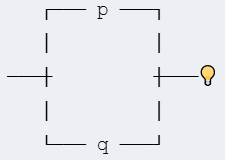
How it works: The lamp lights if at least one switch is closed.
Circuit states:
| State | Result |
|---|---|
| p=0, q=0 (both open) | Off |
| p=0, q=1 (q closed) | On |
| p=1, q=0 (p closed) | On |
| p=1, q=1 (both closed) | On |
| p | q | p ∨ q | Lamp |
|---|---|---|---|
| 0 | 0 | 0 | Off |
| 0 | 1 | 1 | On |
| 1 | 0 | 1 | On |
| 1 | 1 | 1 | On |
Boolean Notation: \( S = p + q \)
3. NOT Circuit (Negation) – Inverter
The NOT circuit corresponds to logical negation (¬p). It uses a single switch representing a negated variable.
───── ¬p ─────💡
How it works: The lamp is on when the switch ¬p is closed (meaning p is false). When p is true, ¬p opens and the lamp turns off.
Circuit states:
| State | Diagram | Result |
|---|---|---|
| p=0 | ─── ● ───💡(closed) | On |
| p=1 | ─── ○ ───○(open) | Off |
| p | ¬p | Lamp |
|---|---|---|
| 0 | 1 | On |
| 1 | 0 | Off |
Boolean Notation: \( S = \overline{p} \) or \( S = p’ \)
Logic Gates Summary
| Gate | Symbol | Expression | Description |
|---|---|---|---|
| AND | ∧ | p · q | Output 1 if both inputs are 1 |
| OR | ∨ | p + q | Output 1 if at least one input is 1 |
| NOT | ¬ | p̄ | Inverts the input |
| NAND | ⊼ | ¬(p · q) | Negation of AND |
| NOR | ⊽ | ¬(p + q) | Negation of OR |
| XOR | ⊕ | p ⊕ q | Output 1 if inputs are different |
| XNOR | ⊙ | ¬(p ⊕ q) | Output 1 if inputs are equal |
| IMPLY* | → | ¬p + q | Conditional: false only if p=1, q=0 |
Note: The IMPLY gate (*) does not exist as a dedicated integrated circuit. It’s built by combining NOT + OR.
Building Circuits from Expressions
Method:
- Identify the variables (propositions) involved
- Analyze the logical expression from inside out
- Connect switches according to operations:
- AND → Series
- OR → Parallel
- NOT → Inverter switch
- Verify with truth table
Example: Circuit for (p ∧ q) ∨ r
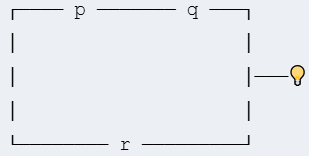
Circuit Simplification (Boolean Algebra)
| Law | Form |
|---|---|
| Identity | p ∧ 1 ≡ p p ∨ 0 ≡ p |
| Domination | p ∧ 0 ≡ 0 p ∨ 1 ≡ 1 |
| Idempotence | p ∧ p ≡ p p ∨ p ≡ p |
| Complement | p ∧ ¬p ≡ 0 p ∨ ¬p ≡ 1 |
| Double Neg. | ¬(¬p) ≡ p |
| De Morgan | ¬(p ∧ q) ≡ ¬p ∨ ¬q ¬(p ∨ q) ≡ ¬p ∧ ¬q |
| Distributive | p ∧ (q ∨ r) ≡ (p∧q) ∨ (p∧r) p ∨ (q ∧ r) ≡ (p∨q) ∧ (p∨r) |
| Absorption | p ∧ (p ∨ q) ≡ p p ∨ (p ∧ q) ≡ p |
Worked Exercises
Exercise 1
Find the equivalent circuit:
![A diagram representing a logic circuit for the schema [(¬p ∧ ¬q) ∨ p ∨ q] ∧ {p ∨ [q ∧ (¬r ∨ ¬p)]}](https://ciencias-basicas.com/wp-content/uploads/2026/01/image-2.png "Logic Circuits Exercises")
Solution
Step 1: Identify the circuit structure
The circuit consists of two main blocks connected in series (one feeding into the other):
- Block A (left): Three branches in parallel
- Block B (right): Mixed structure with parallel branches
Key rule: Blocks in SERIES equal conjunction (∧)
Step 2: Translate each block to logical expression
Block A:
- Upper branch: ¬p ── ¬q (series) is (¬p ∧ ¬q)
- Middle branch: p
- Lower branch: q
The three branches are in parallel: \( \mathrm{A} = (¬ \mathrm{p} ∧ ¬ \mathrm{q} ) ∨ \mathrm{p} ∨ \mathrm{q} \)
Block B:
- Upper branch: p
- Lower branch: q in series with (¬r ∥ ¬p)
Structure: B = p ∨ [q ∧ (¬r ∨ ¬p)]
Total expression (series between blocks):
\( \begin{align} \mathrm{S} & = \mathrm{A} ∧ \mathrm{B} \\ & = [(¬ \mathrm{p} ∧ ¬ \mathrm{q} ) ∨ \mathrm{p} ∨ \mathrm{q} ] ∧ \{ \mathrm{p} ∨ [ \mathrm{q} ∧ (¬ \mathrm{r} ∨ ¬ \mathrm{p} )] \} \end{align} \)
Step 3: Simplify Block A
| Step | Expression | Law Applied |
|---|---|---|
| 1 | (¬p ∧ ¬q) ∨ p ∨ q | Original expression |
| 2 | \( \mathrm{ (¬p ∧ ¬q) ∨ (p ∨ q) } \) | Grouping |
| 3 | ¬(p ∨ q) ∨ (p ∨ q) | De Morgan: ¬p ∧ ¬q ≡ ¬(p ∨ q) |
| 4 | T (Tautology) | Complement: ssX ∨ ¬X ≡ T |
✅ Block A = T
Step 4: Simplify Block B
| Step | Expression | Law Applied |
|---|---|---|
| 1 | p ∨ [q ∧ (¬r ∨ ¬p)] | Original expression |
| 2 | p ∨ [(q ∧ ¬r) ∨ (q ∧ ¬p)] | Distributive |
| 3 | p ∨ (q ∧ ¬r) ∨ (q ∧ ¬p) | Associative |
| 4 | \( [ \mathrm{p} ∨ ( \mathrm{q} ∧ ¬ \mathrm{p} )] ∨ ( \mathrm{q} ∧ ¬ \mathrm{r} ) \) | Regrouping |
| 5 | (p ∨ q) ∨ (q ∧ ¬r) | Absorption: p ∨ (q ∧ ¬p) ≡ p ∨ q |
| 6 | p ∨ q | Absorption: \( ( \mathrm{p} ∨ \mathrm{q} ) ∨ ( \mathrm{q} ∧ \mathrm{X} ) ≡ \mathrm{p} ∨ \mathrm{q} \) |
✅ Block B = p ∨ q
Step 5: Calculate the final expression
| Step | Expression | Law Applied |
|---|---|---|
| 1 | A ∧ B | Series between blocks |
| 2 | T ∧ (p ∨ q) | Substitution |
| 3 | p ∨ q | Identity: T ∧ X ≡ X |
Result: The equivalent circuit is:
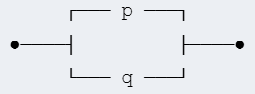
Logical expression: p ∨ q
Takeaway: What looks like a complex circuit with 7 switches and 2 blocks simplifies to just 2 switches in parallel. This shows the real power of Boolean algebra for circuit optimization.
Exercise 2
Build the equivalent logic circuit for the schema:
\( [(p \rightarrow q) \lor p] \land [(p \rightarrow q) \lor \neg p] \)
Solution
Step 1: Identify the structure
The expression has the form:
[A ∨ p] ∧ [A ∨ ¬p] where A = (p → q)
Step 2: Convert the conditional
We apply Material Implication: p → q ≡ ¬p ∨ q
Substituting:
\( [(\neg p \lor q) \lor p] \land [(\neg p \lor q) \lor \neg p] \)
Step 3: Simplify each bracket separately
Left bracket: (¬p ∨ q) ∨ p
| Step | Expression | Law Applied |
|---|---|---|
| 1 | (¬p ∨ q) ∨ p | Original |
| 2 | \( \mathrm{ (¬p ∨ p) ∨ q } \) | Associative and Commutative |
| 3 | T ∨ q | Complement: ¬p ∨ p ≡ T |
| 4 | T | Domination: T ∨ X ≡ T |
✅ Left bracket = T
Right bracket: (¬p ∨ q) ∨ ¬p
| Step | Expression | Law Applied |
|---|---|---|
| 1 | \( (¬ \mathrm{p} ∨ \mathrm{q} ) ∨ ¬ \mathrm{p} \) | Original |
| 2 | (¬p ∨ ¬p) ∨ q | Associative and Commutative |
| 3 | ¬p ∨ q | Idempotence: ¬p ∨ ¬p ≡ ¬p |
✅ Right bracket = ¬p ∨ q
Step 4: Combine the results
| Step | Expression | Law Applied |
|---|---|---|
| 1 | [T] ∧ [¬p ∨ q] | Substitution |
| 2 | ¬p ∨ q | Identity: T ∧ X ≡ X |
Result: The equivalent logic circuit is:
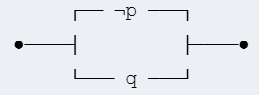
Logical expression: ¬p ∨ q
Takeaway: The expression ¬p ∨ q is equivalent to p → q (material implication). So the complex original circuit simplifies to a basic parallel circuit representing the conditional.
Exercise 3
Build the simplest equivalent logic circuit for:
![A diagram representing a logic circuit for the schema ( ¬p ∧ [(p ∧ ¬q) ∨ (¬p ∨ q)] ∨ [(r ∧ s ∧ t) ∨ (r ∨ s ∨ t)] ∧ [(r ∨ s ∨ t) ∨ (r ∧ s ∧ t)] ) ∧ ¬p](https://ciencias-basicas.com/wp-content/uploads/2026/01/image-5.png "Logic Circuits Exercises")
Solution
Step 1: Identify the general structure
The circuit has the form: (A ∨ B) ∧ C
Where:
- Block A = ¬p in series with [(p ∧ ¬q) ∨ ¬p ∨ q]
- Block B = Left sub-block in series with Right sub-block
- Block C = ¬p
- A and B are in parallel with each other
- The set (A ∨ B) is in series with C
Step 2: Translate each block to logical expression
| Block | Expression |
|---|---|
| A | ¬p ∧ [(p ∧ ¬q) ∨ (¬p ∨ q)] |
| B | \( [( \mathrm{r} ∧ \mathrm{s} ∧ \mathrm{t} ) ∨ ( \mathrm{r} ∨ \mathrm{s} ∨ \mathrm{t} )] ∧ [( \mathrm{r} ∨ \mathrm{s} ∨ \mathrm{t} ) ∨ ( \mathrm{r} ∧ \mathrm{s} ∧ \mathrm{t} )] \) |
| C | ¬p |
Step 3: Simplify Block A
| Step | Expression | Law Applied |
|---|---|---|
| 1 | ¬p ∧ [(p ∧ ¬q) ∨ (¬p ∨ q)] | Original |
| 2 | \( ¬ \mathrm{p} ∧ [( \mathrm{p} ∧ ¬ \mathrm{q} ) ∨ ¬( \mathrm{p} ∧ ¬ \mathrm{q} )] \) | De Morgan: \( ¬ \mathrm{p} ∨ \mathrm{q} ≡ ¬( \mathrm{p} ∧ ¬ \mathrm{q} ) \) |
| 3 | ¬p ∧ T | Complement: X ∨ ¬X ≡ T |
| 4 | ¬p | Identity: X ∧ T ≡ X |
✅ Block A = ¬p
Step 4: Simplify Block B
Notice that B has the form: \( [ \mathrm{X} ∨ \mathrm{Y} ] ∧ [ \mathrm{Y} ∨ \mathrm{X} ] \) where:
- X = (r ∧ s ∧ t) — series
- Y = (r ∨ s ∨ t) — parallel
| Step | Expression | Law Applied |
|---|---|---|
| 1 | \( [( \mathrm{r} ∧ \mathrm{s} ∧ \mathrm{t} ) ∨ ( \mathrm{r} ∨ \mathrm{s} ∨ \mathrm{t} )] ∧ [( \mathrm{r} ∨ \mathrm{s} ∨ \mathrm{t} ) ∨ ( \mathrm{r} ∧ \mathrm{s} ∧ \mathrm{t} )] \) | Original |
| 2 | [r ∨ s ∨ t] ∧ [r ∨ s ∨ t] | Absorption: \( ( \mathrm{X} ∧ \mathrm{Y} ∧ \mathrm{Z} ) ∨ ( \mathrm{X} ∨ \mathrm{Y} ∨ \mathrm{Z} ) ≡ \mathrm{X} ∨ \mathrm{Y} ∨ \mathrm{Z} \) |
| 3 | r ∨ s ∨ t | Idempotence: X ∧ X ≡ X |
✅ Block B = r ∨ s ∨ t
Step 5: Calculate (A ∨ B) ∧ C
| Step | Expression | Law Applied |
|---|---|---|
| 1 | (A ∨ B) ∧ C | Original structure |
| 2 | \( [¬ \mathrm{p} ∨ ( \mathrm{r} ∨ \mathrm{s} ∨ \mathrm{t} )] ∧ ¬ \mathrm{p} \) | Substitution |
| 3 | ¬p | Absorption: (X ∨ Y) ∧ X ≡ X |
Result: The equivalent circuit is:
M ●─── ¬p ───● N
Logical expression: ¬p
Takeaway: A seemingly complex circuit with multiple blocks and over 10 switches simplifies down to just one inverter switch (¬p). This powerfully demonstrates how Boolean algebra can optimize circuits.
Exercise 4
Describe the circuit symbolically:
![A diagram representing a logic circuit for the schema [p ∧ (r ∨ ¬q)] ∨ (q ∧ ¬r)](https://ciencias-basicas.com/wp-content/uploads/2026/01/image-6.png "Logic Circuits Exercises")
Solution
Step 1: Identify the general structure
The circuit has two main branches in parallel:
- Upper branch: p in series with a sub-block
- Lower branch: q in series with ¬r
Step 2: Analyze each branch
Upper branch:
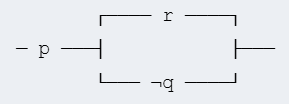
- p is in series with a parallel block of (r ∥ ¬q)
- Expression: p ∧ (r ∨ ¬q)
Lower branch:
─── q ─── ¬r ───
- q is in series with ¬r
- Expression: q ∧ ¬r
Step 3: Combine the branches
The two branches are in parallel (disjunction):
| Structure | Expression |
|---|---|
| Upper branch | p ∧ (r ∨ ¬q) |
| Lower branch | q ∧ ¬r |
| Complete circuit | [p ∧ (r ∨ ¬q)] ∨ (q ∧ ¬r) |
Result:
Symbolic expression of the circuit:
[p ∧ (r ∨ ¬q)] ∨ (q ∧ ¬r)
Exercise 5
Find the smallest expression that represents the given circuit:
![A diagram representing a logic circuit for the schema [p ∨ q ∨ (¬q ∧ ¬p)] ∧ ¬p](https://ciencias-basicas.com/wp-content/uploads/2026/01/image-7.png "Logic Circuits Exercises")
Solution
Step 1: Translate the circuit to logical expression
The circuit has:
- Parallel block: p ∥ q ∥ (¬q — ¬p)
- This block is in series with ¬p
Initial expression: [p ∨ q ∨ (¬q ∧ ¬p)] ∧ ¬p
Step 2: Simplify the internal parallel block
First we simplify: q ∨ (¬q ∧ ¬p)
| Step | Expression | Law Applied |
|---|---|---|
| 1 | q ∨ (¬q ∧ ¬p) | Original |
| 2 | (q ∨ ¬q) ∧ (q ∨ ¬p) | Distributive |
| 3 | T ∧ (q ∨ ¬p) | Complement |
| 4 | q ∨ ¬p | Identity |
Step 3: Substitute and continue simplifying
| Step | Expression | Law Applied |
|---|---|---|
| 1 | [p ∨ (q ∨ ¬p)] ∧ ¬p | Substitution |
| 2 | \( [( \mathrm{p} ∨ ¬ \mathrm{p} ) ∨ \mathrm{q} ] ∧ ¬ \mathrm{p} \) | Associative and Commutative |
| 3 | [T ∨ q] ∧ ¬p | Complement |
| 4 | T ∧ ¬p | Domination |
| 5 | ¬p | Identity |
Result:
The smallest expression is: ¬p
Equivalent circuit:
●─── ¬p ───●
Takeaway: A circuit with 3 parallel branches and 4 switches simplifies down to just one inverter switch.
Exercise 6
Determine the logic circuit that represents the molecular schema:
¬[p → ¬(q ∨ r)]
Solution
Step 1: Convert the conditional using Material Implication
p → X ≡ ¬p ∨ X
| Step | Expression | Law Applied |
|---|---|---|
| 1 | ¬[p → ¬(q ∨ r)] | Original |
| 2 | ¬[¬p ∨ ¬(q ∨ r)] | Material Implication |
Step 2: Apply De Morgan to the outer negation
| Step | Expression | Law Applied |
|---|---|---|
| 3 | \( ¬(¬ \mathrm{p} ) ∧ ¬[¬( \mathrm{q} ∨ \mathrm{r} ) ] \) | De Morgan: ¬(A ∨ B) ≡ ¬A ∧ ¬B |
| 4 | p ∧ (q ∨ r) | Double Negation (×2) |
Result:
Simplified expression: p ∧ (q ∨ r)
Equivalent logic circuit:
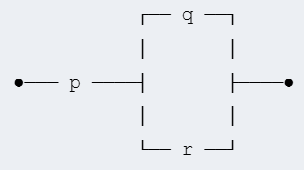
Takeaway: An expression with nested negations and a conditional simplifies to a very basic circuit: p in series with (q ∨ r).
Exercise 7
Find the simplest equivalent proposition for the following logic circuit:
![A diagram representing a logic circuit for the schema [p ∨ q ∨ (¬p ∧ ¬q)] ∧ [(¬p ∨ q) ∧ p]](https://ciencias-basicas.com/wp-content/uploads/2026/01/image-13.png "Logic Circuits Exercises")
Solution
Step 1: Translate the circuit to logical expression
- Block A: p ∨ q ∨ (¬p ∧ ¬q)
- Block B: ¬p ∨ q
- Final series: p
- Complete expression:
[p ∨ q ∨ (¬p ∧ ¬q)] ∧ [(¬p ∨ q) ∧ p]
Step 2: Simplify Block A
| Step | Expression | Law Applied |
|---|---|---|
| 1 | \( \mathrm{p} ∨ \mathrm{q} ∨ (¬ \mathrm{p} ∧ ¬ \mathrm{q} ) \) | Original |
| 2 | (p ∨ q) ∨ ¬(p ∨ q) | De Morgan: ¬p ∧ ¬q ≡ ¬(p ∨ q) |
| 3 | T | Complement: X ∨ ¬X ≡ T |
✅ Block A = T
Step 3: Simplify (Block B ∧ p)
| Step | Expression | Law Applied |
|---|---|---|
| 1 | (¬p ∨ q) ∧ p | Original |
| 2 | \( (¬ \mathrm{p} ∧ \mathrm{p} ) ∨ ( \mathrm{q} ∧ \mathrm{p} ) \) | Distributive |
| 3 | F ∨ (p ∧ q) | Complement: ¬p ∧ p ≡ F |
| 4 | p ∧ q | Identity: F ∨ X ≡ X |
✅ Block B ∧ p = p ∧ q
Step 4: Combine
| Step | Expression | Law Applied |
|---|---|---|
| 1 | T ∧ (p ∧ q) | Substitution |
| 2 | p ∧ q | Identity: T ∧ X ≡ X |
Result:
Simplified expression: p ∧ q
Equivalent circuit:
●────── p ────── q ──────●
Takeaway: A circuit with 2 complex blocks (7 switches) simplifies to just 2 switches in series.
Exercise 8
Find the smallest expression that represents the given circuit:
![A diagram representing a logic circuit for the schema (¬p ∧ ¬q) ∨ [p ∧ (¬p ∨ q)]](https://ciencias-basicas.com/wp-content/uploads/2026/01/image-14.png "Logic Circuits Exercises")
Solution
Step 1: Translate the circuit to logical expression
The circuit has two main branches in parallel:
- Upper branch: ¬p in series with ¬q then \( \mathrm{ (¬p ∧ ¬q) } \)
- Lower branch: p in series with (¬p ∥ q) then \( \mathrm{ p ∧ (¬p ∨ q) } \)
Initial expression: (¬p ∧ ¬q) ∨ [p ∧ (¬p ∨ q)]
Step 2: Simplify the lower branch
| Step | Expression | Law Applied |
|---|---|---|
| 1 | p ∧ (¬p ∨ q) | Original |
| 2 | \( ( \mathrm{p} ∧ ¬ \mathrm{p} ) ∨ ( \mathrm{p} ∧ \mathrm{q} ) \) | Distributive |
| 3 | F ∨ (p ∧ q) | Complement: p ∧ ¬p ≡ F |
| 4 | p ∧ q | Identity: F ∨ X ≡ X |
Step 3: Substitute and recognize the pattern
| Step | Expression | Observation |
|---|---|---|
| 1 | \( (¬ \mathrm{p} ∧ ¬ \mathrm{q} ) ∨ ( \mathrm{p} ∧ \mathrm{q} ) \) | Substitution |
| 2 | p ↔ q | This is the definition of the biconditional |
Note: p ↔ q ≡ (p ∧ q) ∨ (¬p ∧ ¬q) — the biconditional is true when both have the same value
Result:
The smallest expression is: p ↔ q
Equivalent circuit (conceptual):
●────── p ↔ q ──────●
Takeaway: This circuit implements the XNOR operation (logical equivalence): the output is 1 when both inputs have the same value.
Exercise 9
Find the smallest expression that represents the given circuit:
![A diagram representing a logic circuit for the schema (p ∨ q) ∧ [(¬q ∧ (r ∨ ¬q)) ∨ (p ∧ q)] ∧ r](https://ciencias-basicas.com/wp-content/uploads/2026/01/image-15.png "Logic Circuits Exercises")
Solution
Step 1: Translate the circuit to logical expression
- Block 1 (parallel): p ∨ q
- Block 2 (parallel): [¬q ∧ (r ∨ ¬q)] ∨ (p ∧ q)
- Final series: r
Initial expression: \( ( \mathrm{p} ∨ \mathrm{q} ) ∧ [(¬ \mathrm{q} ∧ ( \mathrm{r} ∨ ¬ \mathrm{q} )) ∨ ( \mathrm{p} ∧ \mathrm{q} )] ∧ \mathrm{r} \)
Step 2: Simplify ¬q ∧ (r ∨ ¬q)
| Step | Expression | Law Applied |
|---|---|---|
| 1 | ¬q ∧ (r ∨ ¬q) | Original |
| 2 | ¬q | Absorption: X ∧ (Y ∨ X) ≡ X |
Step 3: Simplify [¬q ∨ (p ∧ q)]
| Step | Expression | Law Applied |
|---|---|---|
| 1 | ¬q ∨ (p ∧ q) | Substitution |
| 2 | (¬q ∨ p) ∧ (¬q ∨ q) | Distributive |
| 3 | (¬q ∨ p) ∧ T | Complement |
| 4 | p ∨ ¬q | Identity |
Step 4: Simplify (p ∨ q) ∧ (p ∨ ¬q)
| Step | Expression | Law Applied |
|---|---|---|
| 1 | (p ∨ q) ∧ (p ∨ ¬q) | Substitution |
| 2 | p ∨ (q ∧ ¬q) | Inverse Distributive |
| 3 | p ∨ F | Complement |
| 4 | p | Identity |
Step 5: Final result
| Step | Expression | Law Applied |
|---|---|---|
| 1 | p ∧ r | Substitution |
Result:
The smallest expression is: p ∧ r
Equivalent circuit:
●────── p ────── r ──────●
Takeaway: A complex circuit with 8 switches simplifies to just 2 switches in series.
Exercise 10
Find the equivalent circuit:
![A diagram representing a logic circuit for the schema [(¬p ∧ ¬q) ∨ p ∨ q] ∧ {p ∨ [q ∧ (¬r ∨ ¬p)]}](https://ciencias-basicas.com/wp-content/uploads/2026/01/image-17.png "Logic Circuits Exercises")
Solution
Step 1: Translate the circuit to logical expression
- Block A: (¬p ∧ ¬q) ∨ p ∨ q
- Block B: p ∨ [q ∧ (¬r ∨ ¬p)]
Initial expression: \( [(¬ \mathrm{p} ∧ ¬ \mathrm{q} ) ∨ \mathrm{p} ∨ \mathrm{q} ] ∧ \{ \mathrm{p} ∨ [ \mathrm{q} ∧ (¬ \mathrm{r} ∨ ¬ \mathrm{p} )] \} \)
Step 2: Simplify Block A
| Step | Expression | Law Applied |
|---|---|---|
| 1 | (¬p ∧ ¬q) ∨ p ∨ q | Original |
| 2 | \( (¬ \mathrm{p} ∧ ¬ \mathrm{q} ) ∨ ( \mathrm{p} ∨ \mathrm{q} ) \) | Regroup |
| 3 | ¬(p ∨ q) ∨ (p ∨ q) | De Morgan |
| 4 | T | Complement: X ∨ ¬X ≡ T |
✅ Block A = T
Step 3: Simplify Block B
| Step | Expression | Law Applied |
|---|---|---|
| 1 | p ∨ [q ∧ (¬r ∨ ¬p)] | Original |
| 2 | \( \mathrm{p} ∨ [( \mathrm{q} ∧ ¬ \mathrm{r} ) ∨ ( \mathrm{q} ∧ ¬ \mathrm{p} )] \) | Distributive |
| 3 | p ∨ (q ∧ ¬r) ∨ (q ∧ ¬p) | Regroup |
| 4 | [p ∨ (q ∧ ¬p)] ∨ (q ∧ ¬r) | Regroup |
| 5 | (p ∨ q) ∨ (q ∧ ¬r) | Absorption: p ∨ (q ∧ ¬p) ≡ p ∨ q |
| 6 | p ∨ q | Absorption: \( ( \mathrm{p} ∨ \mathrm{q} ) ∨ ( \mathrm{q} ∧ \mathrm{X} ) ≡ \mathrm{p} ∨ \mathrm{q} \) |
✅ Block B = p ∨ q
Step 4: Combine
| Step | Expression | Law Applied |
|---|---|---|
| 1 | T ∧ (p ∨ q) | Substitution |
| 2 | p ∨ q | Identity: T ∧ X ≡ X |
Result:
Simplified expression: p ∨ q
Equivalent circuit:
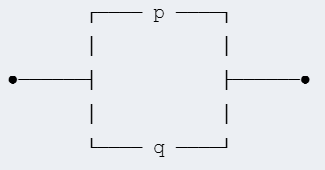
Takeaway: A circuit with 2 complex blocks (9 switches) reduces to just 2 switches in parallel.
Exercise 11
Find the proposition x such that the simplified circuit is a tautology:
![A diagram representing a logic circuit for the schema [ {(¬p ∧ ¬q) ∨ (p ∧ q)} ∧ {p ∨ [q ∧ (¬p ∨ x)]} ∧ (¬q) ] ∨ [ [(p ∧ q) ∨ (p ∧ ¬q)] ∨ {[r ∨ (¬p ∧ ¬r)] ∧ x} ]](https://ciencias-basicas.com/wp-content/uploads/2026/01/image-21.png "Logic Circuits Exercises")
Solution
Step 1: Identify the general structure
The circuit has two main blocks in parallel:
- P = Q ∨ R
Where:
- Q = Upper circuit (top branch)
- R = Lower circuit (bottom branch)
For P to be a tautology (always T), we need to find the value of x.
Step 2: Translate each block to logical expression
| Block | Expression |
|---|---|
| Q | \( { (¬ \mathrm{p} ∧ ¬ \mathrm{q} ) ∨ ( \mathrm{p} ∧ \mathrm{q} ) } ∧ { \mathrm{p} ∨ [ \mathrm{q} ∧ (¬ \mathrm{p} ∨ \mathrm{x} )] } ∧ (¬ \mathrm{q} ) \) |
| R | [(p ∧ q) ∨ (p ∧ ¬q)] ∨ {[r ∨ (¬p ∧ ¬r)] ∧ x} |
Step 3: Simplify Q (testing our hypothesis: x = ¬p)
Let’s try x = ¬p and see if it makes the circuit a tautology:
3.1: Simplify {p ∨ [q ∧ (¬p ∨ ¬p)]}
| Step | Expression | Law Applied |
|---|---|---|
| 1 | p ∨ [q ∧ (¬p ∨ ¬p)] | Substitution: x = ¬p |
| 2 | p ∨ [q ∧ ¬p] | Idempotence: ¬p ∨ ¬p ≡ ¬p |
| 3 | (p ∨ q) ∧ (p ∨ ¬p) | Distributive |
| 4 | (p ∨ q) ∧ T | Complement |
| 5 | p ∨ q | Identity |
3.2: Now Q = {(¬p ∧ ¬q) ∨ (p ∧ q)} ∧ (p ∨ q) ∧ (¬q)
| Step | Expression | Law Applied |
|---|---|---|
| 1 | \( { (¬ \mathrm{p} ∧ ¬ \mathrm{q} ) ∨ ( \mathrm{p} ∧ \mathrm{q} ) } ∧ ( \mathrm{p} ∨ \mathrm{q} ) \) | Simplifying these first |
| 2 | (p ∧ q) | Absorption: the term \( (¬ \mathrm{p} ∧ ¬ \mathrm{q} ) \) is absorbed |
| 3 | (p ∧ q) ∧ (¬q) | Add the last term |
| 4 | p ∧ (q ∧ ¬q) | Associative |
| 5 | p ∧ F | Complement: q ∧ ¬q ≡ F |
| 6 | F | Domination |
✅ Q = F (Contradiction)
Step 4: Since Q = F, then P = F ∨ R = R
Now we only need R = T for P to be a tautology.
Step 5: Simplify R (with x = ¬p)
5.1: Simplify [(p ∧ q) ∨ (p ∧ ¬q)]
| Step | Expression | Law Applied |
|---|---|---|
| 1 | (p ∧ q) ∨ (p ∧ ¬q) | Original |
| 2 | p ∧ (q ∨ ¬q) | Inverse Distributive |
| 3 | p ∧ T | Complement |
| 4 | p | Identity |
5.2: Simplify [r ∨ (¬p ∧ ¬r)] ∧ ¬p
| Step | Expression | Law Applied |
|---|---|---|
| 1 | [r ∨ (¬p ∧ ¬r)] ∧ ¬p | Substitution: \( \mathrm{x} = ¬ \mathrm{p} \) |
| 2 | \( [( \mathrm{r} ∨ ¬ \mathrm{p} ) ∧ ( \mathrm{r} ∨ ¬ \mathrm{r} )] ∧ ¬ \mathrm{p} \) | Distributive |
| 3 | [(r ∨ ¬p) ∧ T] ∧ ¬p | Complement |
| 4 | (r ∨ ¬p) ∧ ¬p | Identity |
| 5 | ¬p | Absorption: ss(X ∨ Y) ∧ Y ≡ Y |
5.3: Now R = p ∨ ¬p
| Step | Expression | Law Applied |
|---|---|---|
| 1 | p ∨ ¬p | Combination |
| 2 | T | Complement |
✅ R = T (Tautology)
Step 6: Final verification
| Expression | Value |
|---|---|
| Q | F |
| R | T |
| P = Q ∨ R | F ∨ T = T ✅ |
Result
For the circuit to be a tautology: x = ¬p
Takeaway: This exercise showcases an advanced technique: finding unknown variable values that make a complex circuit become a tautology. The key was hypothesizing x = ¬p and systematically verifying that the result is always true.
Exercise 12
Build the simplest equivalent logic circuit for:
![A diagram representing a logic circuit for the schema [ ( ¬p ∧ [(p ∧ ¬q) ∨ ¬p ∨ q] ) ∨ ( [(r ∧ s ∧ t) ∨ r ∨ s ∨ t] ∧ [(r ∨ s ∨ t) ∨ (r ∧ s ∧ t)] ) ] ∧ ¬p](https://ciencias-basicas.com/wp-content/uploads/2026/01/image-22.png "Logic Circuits Exercises")
Solution
Step 1: Identify the general structure
The circuit has the form: (A ∨ B) ∧ C
Where:
- A = Upper block (with ¬p, p, q)
- B = Lower blocks (with r, s, t)
- C = ¬p (at the end)
Step 2: Translate each block to logical expression
| Block | Expression |
|---|---|
| A | ¬p ∧ [(p ∧ ¬q) ∨ ¬p ∨ q] |
| B | \( [( \mathrm{r} ∧ \mathrm{s} ∧ \mathrm{t} ) ∨ \mathrm{r} ∨ \mathrm{s} ∨ \mathrm{t} ] ∧ [( \mathrm{r} ∨ \mathrm{s} ∨ \mathrm{t} ) ∨ ( \mathrm{r} ∧ \mathrm{s} ∧ \mathrm{t} )] \) |
| C | ¬p |
Step 3: Simplify Block A
| Step | Expression | Law Applied |
|---|---|---|
| 1 | ¬p ∧ [(p ∧ ¬q) ∨ ¬p ∨ q] | Original |
| 2 | ¬p ∧ [(p ∧ ¬q) ∨ (¬p ∨ q)] | Regroup |
| 3 | \( ¬ \mathrm{p} ∧ [( \mathrm{p} ∧ ¬ \mathrm{q} ) ∨ ¬( \mathrm{p} ∧ ¬ \mathrm{q} )] \) | De Morgan: \( ¬ \mathrm{p} ∨ \mathrm{q} ≡ ¬( \mathrm{p} ∧ ¬ \mathrm{q} ) \) |
| 4 | ¬p ∧ T | Complement: X ∨ ¬X ≡ T |
| 5 | ¬p | Identity: X ∧ T ≡ X |
✅ Block A = ¬p
Step 4: Simplify Block B
4.1: Each sub-block of B:
| Sub-block | Expression | Simplification |
|---|---|---|
| Left | \( ( \mathrm{r} ∧ \mathrm{s} ∧ \mathrm{t} ) ∨ \mathrm{r} ∨ \mathrm{s} ∨ \mathrm{t} \) | = r ∨ s ∨ t (by Absorption) |
| Right | (r ∨ s ∨ t) ∨ (r ∧ s ∧ t) | = r ∨ s ∨ t (by Absorption) |
4.2: Combine sub-blocks:
| Step | Expression | Law Applied |
|---|---|---|
| 1 | \( ( \mathrm{r} ∨ \mathrm{s} ∨ \mathrm{t} ) ∧ ( \mathrm{r} ∨ \mathrm{s} ∨ \mathrm{t} ) \) | Substitution |
| 2 | r ∨ s ∨ t | Idempotence: X ∧ X ≡ X |
✅ Block B = r ∨ s ∨ t
Step 5: Calculate (A ∨ B) ∧ C
| Step | Expression | Law Applied |
|---|---|---|
| 1 | (A ∨ B) ∧ C | Original structure |
| 2 | \( [¬ \mathrm{p} ∨ ( \mathrm{r} ∨ \mathrm{s} ∨ \mathrm{t} )] ∧ ¬ \mathrm{p} \) | Substitution |
| 3 | ¬p | Absorption: (X ∨ Y) ∧ X ≡ X |
Result
The simplest equivalent circuit is: ¬p
Equivalent circuit:
A ●──── ¬p ────● B
Takeaway: A massively complex circuit with multiple blocks and over 12 switches simplifies down to just one inverter switch (¬p).
Section VI: Mathematical Proofs
This section covers exercises on mathematical proof methods, including direct proof, contraposition, contradiction, mathematical induction, and proof by cases.
Quick Reference Guide
What is a Mathematical Proof?
A mathematical proof is a rigorous logical argument that establishes the truth of a proposition, starting from axioms, definitions, and previously proven theorems.
A proof is a finite sequence of propositions where each one is:
- An axiom (a truth accepted without proof)
- A definition (an agreed-upon meaning of a term)
- A hypothesis (an initial assumption of the theorem)
- A proposition derived from previous ones using inference rules
Structure of a Theorem
Every theorem has the form: “If P, then Q” (P → Q)
| Component | Name | Role |
|---|---|---|
| P | Hypothesis | What we assume to be true |
| Q | Thesis (or Conclusion) | What we want to prove |
| P → Q | Theorem | The complete implication |
Note: When we prove that a theorem is true, we’re showing that P → Q is a tautology. A proven theorem is really an implication (P ⇒ Q).
Table of Proof Methods
| # | Method | Core Idea | When to Use |
|---|---|---|---|
| 1 | Direct | Assume P, deduce Q | General case, first attempt |
| 2 | Contraposition | Prove ¬Q → ¬P | When Q is easier to negate |
| 3 | Contradiction | Assume ¬(P→Q), reach absurdity | Existence, uniqueness, irrationality |
| 4 | Induction | Base case + inductive step | Properties of natural numbers |
| 5 | By Cases | Divide into subcases | When there are distinct scenarios |
| 6 | Counterexample | A single refuting case | To prove falsity |
1. Direct Proof
The idea is simple: start from the hypothesis and work your way to the conclusion through logical steps.
Steps:
- Assume P is true (hypothesis)
- Apply definitions, axioms, and known theorems
- Through logical steps, deduce that Q is true
- Conclude: P → Q is proven ✓
Example: If n is even, then n² is even.
| Step | Statement | Justification |
|---|---|---|
| 1 | Let n be an even number | Hypothesis |
| 2 | n = 2k, for some integer k | Definition of even |
| 3 | \( \mathrm{n²} = \mathrm{(2k)²} = \mathrm{4k²} = \mathrm{2(2k²)} \) | Algebraic expansion |
| 4 | n² = 2m, where m = 2k² | Substitution |
| 5 | n² is even | By definition ∎ |
2. Proof by Contraposition
This method exploits the logical equivalence: P → Q ≡ ¬Q → ¬P
Structure:
1. We want to prove: P → Q
2. Instead, we prove: ¬Q → ¬P
3. Assume ¬Q (the negation of the conclusion)
4. Through logical steps, deduce ¬P
5. Since ¬Q → ¬P is true, P → Q is also true ✓
Example: If n² is even, then n is even.
Contrapositive: If n is odd, then n² is odd.
| Step | Statement | Justification |
|---|---|---|
| 1 | Suppose n is odd | Assume ¬Q |
| 2 | n = 2k + 1 | Definition of odd |
| 3 | \( \mathrm{n² = (2k + 1)² = 4k² + 4k + 1} \) | Expansion |
| 4 | n² = 2(2k² + 2k) + 1 | Factoring |
| 5 | n² is odd | Has the form 2m + 1 ∎ |
3. Proof by Contradiction
Based on: If assuming something is false leads to a contradiction, then it must be true.
Structure:
- We want to prove: P
- Assume the opposite: ¬P (assumption for contradiction)
- Derive logical consequences from ¬P
- Reach a CONTRADICTION (something impossible)
- Conclude: ¬P is false, therefore P is true ✓
Classic Example: √2 is irrational.
| Step | Statement | Justification |
|---|---|---|
| 1 | Assume that √2 is rational | Assumption (¬P) |
| 2 | √2 = a/b, with a,b having no common factors | Irreducible form |
| 3 | \( \mathrm{2 = a²/b²} \), then \( \mathrm{2b² = a²} \) | Algebra |
| 4 | a² is even, then a is even | Previous theorem |
| 5 | \( \mathrm{a = 2c} \), then \( \mathrm{ 2b² = 4c²} \), \( \mathrm{b² = 2c²} \) | Substitution |
| 6 | b² is even, then b is even | Same argument |
| 7 | CONTRADICTION: \( \mathrm{a} \) and \( \mathrm{b} \) are both even | We said no common factors |
| 8 | √2 is irrational | ∎ |
4. Proof by Mathematical Induction
The go-to method for proving properties that hold for all natural numbers.
Structure:
- Step 1: BASE CASE
- Prove that P(n₀) is true
- Step 2: INDUCTIVE HYPOTHESIS
- Assume P(k) is true for some k ≥ n₀
- Step 3: INDUCTIVE STEP
- Prove that P(k) → P(k+1)
- CONCLUSION: P(n) is true for all n ≥ n₀
Example: 1 + 2 + 3 + … + n = n(n+1)/2
| Phase | Development |
|---|---|
| Base Case (n=1) | 1 = 1(2)/2 = 1 ✓ |
| Hypothesis | 1 + 2 + … + k = k(k+1)/2 |
| Inductive Step | 1 + 2 + … + k + (k+1) = k(k+1)/2 + (k+1) = (k+1)(k+2)/2 ✓ |
5. Proof by Cases
Divides the problem into subcases that cover all possibilities.
Structure:
- 1. Identify all possible cases (exhaustive)
- 2. Prove the conclusion for each case
- 3. Conclude that the theorem is true in all cases
Example: For any integer n, n(n+1) is even.
| Case | Development | Result |
|---|---|---|
| n is even | \( n = 2k \)\( \begin{align} → n(n+1) & = 2k(n+1) \ & = 2[k(n+1)] \end{align} \) | Even ✓ |
| n is odd | \( n+1 \) is even\( \begin{align} → n(n+1) & = n(2m) \ & = 2(nm) \end{align} \) | Even ✓ |
6. Proof by Counterexample
To disprove “For all x, P(x)”, you only need to find one x where P(x) is false.
Examples:
| False Statement | Counterexample |
|---|---|
| “All primes are odd” | 2 is prime and even ✗ |
| “n² > n for all n ≥ 1” | n = 1: 1² = 1, not greater ✗ |
| “The sum of irrationals is irrational” | √2 + (-√2) = 0 (rational) ✗ |
Connection with Propositional Logic
| Method | Logical Basis |
|---|---|
| Direct | P → Q (affirm antecedent, derive consequent) |
| Contraposition | P → Q ≡ ¬Q → ¬P |
| Contradiction | ¬P → Contradiction, therefore P |
| By cases | (P₁ → Q) ∧ (P₂ → Q) ∧ … ⊢ Q |
End of Proof Symbol
The symbol ∎ (or Q.E.D.) indicates that the proof has been completed.
Q.E.D. = “Quod Erat Demonstrandum” = “what was to be demonstrated”
Worked Exercises
Exercise 1
Prove that the cube of an odd number is also odd.
Type: Direct Proof
Solution
Step 1: Establish the hypothesis
Let n be an odd number.
By definition of odd number: n = 2k + 1, where k is an integer.
Step 2: Calculate n³
| Step | Expression | Justification |
|---|---|---|
| 1 | n³ = (2k + 1)³ | Substitution |
| 2 | = (2k + 1)(2k + 1)(2k + 1) | Expansion |
| 3 | = (2k + 1)(4k² + 4k + 1) | Square of a binomial |
| 4 | \( \mathrm{ = 8k³ + 8k² + 2k + 4k² + 4k + 1 } \) | Distributive property |
| 5 | = 8k³ + 12k² + 6k + 1 | Simplification |
Step 3: Factor to show the form 2m + 1
| Step | Expression | Justification |
|---|---|---|
| 6 | \( \mathrm{ n³ = 2(4k³ + 6k² + 3k) + 1 } \) | Factor out 2 |
| 7 | Let \( \mathrm{ m = 4k³ + 6k² + 3k } \) | m is an integer (sum and product of integers) |
| 8 | n³ = 2m + 1 | Substitution |
Step 4: Conclusion
Since n³ has the form 2m + 1 (where m is an integer), n³ is odd by definition.
∎
Takeaway: This proof uses the direct method: we start from the hypothesis (n is odd) and through algebraic steps arrive at the conclusion (n³ is odd). The key pattern is showing that the result has the form 2m + 1.
Exercise 2
In the set of integers, prove that if m and n are multiples of p, then m + n and m − n are also multiples of p.
Type: Direct Proof
Solution
Step 1: Establish the hypotheses
Let m and n be multiples of p.
By definition of multiple:
- m = p · a, where a is an integer
- n = p · b, where b is an integer
Step 2: Prove that m + n is a multiple of p
| Step | Expression | Justification |
|---|---|---|
| 1 | \( \mathrm{ m + n = p·a + p·b } \) | Substitution |
| 2 | = p(a + b) | Factor out p |
| 3 | Let c = a + b | c is an integer (sum of integers) |
| 4 | m + n = p · c | Substitution |
Since m + n = p · c, where c is an integer, m + n is a multiple of p. ✓
Step 3: Prove that m − n is a multiple of p
| Step | Expression | Justification |
|---|---|---|
| 1 | \( \mathrm{ m − n = p·a − p·b } \) | Substitution |
| 2 | = p(a − b) | Factor out p |
| 3 | Let d = a − b | d is an integer (difference of integers) |
| 4 | m − n = p · d | Substitution |
Since m − n = p · d, where d is an integer, m − n is a multiple of p. ✓
Conclusion
If m and n are multiples of p, then both m + n and m − n are multiples of p.
∎
Takeaway: This proof illustrates that the set of multiples of p is closed under addition and subtraction. In algebra, this means that multiples of p form a subgroup of the integers under addition.
Exercise 3
Prove that when two lines intersect, the vertically opposite angles are equal.
Type: Direct Proof (Geometry)
Solution
Step 1: Establish the situation
Let L₁ and L₂ be two lines that intersect at point O.
When they intersect, four angles are formed: α, β, α’, β’
Where:
- α and α’ are vertically opposite angles
- β and β’ are vertically opposite angles
Step 2: Use the supplementary angles property
Adjacent angles formed by two intersecting lines are supplementary (sum to 180°).
| Relationship | Equation |
|---|---|
| α and β are adjacent | α + β = 180° … (1) |
| β and α’ are adjacent | β + α’ = 180° … (2) |
Step 3: Equate the equations
From (1) and (2):
| Step | Expression | Justification |
|---|---|---|
| 1 | α + β = 180° | Equation (1) |
| 2 | β + α’ = 180° | Equation (2) |
| 3 | α + β = β + α’ | Transitive (both = 180°) |
| 4 | α = α’ | Cancel β from both sides |
✅ The vertically opposite angles α and α’ are equal
Step 4: Prove for β and β’ (analogously)
| Relationship | Equation |
|---|---|
| α and β are adjacent | α + β = 180° … (1) |
| α and β’ are adjacent | α + β’ = 180° … (3) |
From (1) and (3):
| Step | Expression | Justification |
|---|---|---|
| 1 | α + β = α + β’ | Transitive |
| 2 | β = β’ | Cancel α |
✅ The vertically opposite angles β and β’ are equal
Conclusion
When two lines intersect, the vertically opposite angles are equal:
- α = α’
- β = β’
∎
Takeaway: This is a fundamental theorem in Euclidean geometry. It relies on the property that angles formed on a straight line sum to 180°.
Exercise 4
Prove that the product of two even numbers is even.
Type: Direct Proof
Solution
Step 1: Establish the hypotheses
Let a and b be even numbers.
By definition of even number:
- a = 2m, where m is an integer
- b = 2n, where n is an integer
Step 2: Calculate the product
| Step | Expression | Justification |
|---|---|---|
| 1 | a · b = (2m)(2n) | Substitution |
| 2 | = 4mn | Multiplication |
| 3 | = 2(2mn) | Factor out 2 |
| 4 | Let k = 2mn | k is an integer |
| 5 | a · b = 2k | Substitution |
Conclusion
Since a · b = 2k (where k is an integer), the product is even by definition.
∎
Takeaway: In fact, the product of an even number with any integer is even, since even × integer = 2m × n = 2(mn).
Exercise 5
Prove that: (m → n) ⇔ (¬n → ¬m)
Type: Direct Proof (by equivalences)
Solution
We’ll prove that both expressions are logically equivalent by transforming them to a common form.
Step 1: Transform (m → n)
| Step | Expression | Justification |
|---|---|---|
| 1 | m → n | Original expression |
| 2 | ≡ ¬m ∨ n | Definition of implication: p → q ≡ ¬p ∨ q |
Step 2: Transform (¬n → ¬m)
| Step | Expression | Justification |
|---|---|---|
| 1 | ¬n → ¬m | Original expression |
| 2 | \( \mathrm{ ≡ ¬(¬n) ∨ ¬m } \) | Definition of implication |
| 3 | ≡ n ∨ ¬m | Double negation: ¬(¬p) ≡ p |
| 4 | ≡ ¬m ∨ n | Commutativity of disjunction |
Step 3: Compare results
| Original Expression | Equivalent Form |
|---|---|
| m → n | ¬m ∨ n |
| ¬n → ¬m | ¬m ∨ n |
Both expressions are equivalent to ¬m ∨ n, therefore: (m → n) ⇔ (¬n → ¬m) ∎
Verification with Truth Table:
| m | n | m → n | ¬n → ¬m |
|---|---|---|---|
| T | T | T | T |
| T | F | F | F |
| F | T | T | T |
| F | F | T | T |
The columns are identical, confirming the equivalence. ✓
Takeaway: This is the Law of Contraposition, fundamental in logic and mathematics. It says that “If P then Q” is logically equivalent to “If not Q then not P”.
Exercise 6
Prove that the product of two rational numbers is rational.
Type: Direct Proof
Solution
Step 1: Establish the hypothesis
Let a and b be rational numbers.
By definition of rational number:
- \( \mathrm{ a = \frac{p}{q} } \), where p, q ∈ ℤ and q ≠ 0
- \( \mathrm{ b = \frac{r}{s} } \), where r, s ∈ ℤ and s ≠ 0
Step 2: Calculate the product
| Step | Expression | Justification |
|---|---|---|
| 1 | \( \mathrm{ a \cdot b = \frac{p}{q} \cdot \frac{r}{s} } \) | Substitution |
| 2 | \( = \mathrm{ \frac{p \cdot r}{q \cdot s} } \) | Fraction multiplication |
| 3 | \( = \mathrm{ \frac{ pr }{ qs} } \) | Simplified notation |
Step 3: Verify that the result is rational
| Condition | Verification |
|---|---|
| Is pr an integer? | Yes, product of integers is an integer ✓ |
| Is qs an integer? | Yes, product of integers is an integer ✓ |
| Is qs ≠ 0? | Yes, because q ≠ 0 and s ≠ 0 ✓ |
Conclusion:
Since \( \mathrm{ a \cdot b = \frac{pr}{qs} } \) is the quotient of two integers with non-zero denominator, the product is rational.
\[ \mathrm{ a, b \in \mathbb{Q} \Rightarrow a \cdot b \in \mathbb{Q} } \]
Takeaway: This result shows that ℚ is closed under multiplication. Together with closure under addition (Exercise 7), this means that ℚ forms a field.
Exercise 7
Prove that the sum of two rational numbers is rational.
Type: Direct Proof
Solution
Step 1: Establish the hypothesis
Let a and b be rational numbers.
By definition:
- \( \mathrm{ a = \frac{p}{q} } \) where p, q ∈ ℤ and q ≠ 0
- \( \mathrm{ b = \frac{r}{s} } \) where r, s ∈ ℤ and s ≠ 0
Step 2: Calculate the sum
| Step | Expression | Justification |
|---|---|---|
| 1 | \( \mathrm{ a+b= \frac{p}{q} + \frac{r}{s} } \) | Substitution |
| 2 | \( = \frac{ ps +qr }{qs} \) | Addition of fractions (common denominator) |
Step 3: Verify that the result is rational
| Condition | Verification |
|---|---|
| Is ps + qr an integer? | Yes (sums and products of integers) ✓ |
| Is qs an integer? | Yes (product of integers) ✓ |
| Is qs ≠ 0? | Yes, because q ≠ 0 and s ≠ 0 ✓ |
Conclusion
Since \( a+b = \frac{ps + qr}{qs} \) satisfies the definition of a rational number, the sum is rational.
\[ \mathrm{ a,b \in \mathbb{Q} \Rightarrow a+b \in \mathbb{Q} } ∎ \]
Takeaway: ℚ is closed under addition, subtraction, multiplication, and division (except by zero). This makes ℚ an ordered field.
Exercise 8
For all x ∈ ℝ, x² ≥ 0.
Type: Proof by Cases
Solution
Key insight: Every real number x falls into exactly one category: positive, negative, or zero.
Let’s analyze each case:
Case 1: x = 0
| Step | Statement | Justification |
|---|---|---|
| 1 | x = 0 | Case hypothesis |
| 2 | x² = 0² = 0 | Calculation |
| 3 | 0 ≥ 0 | True ✓ |
Case 2: x > 0
| Step | Statement | Justification |
|---|---|---|
| 1 | x > 0 | Case hypothesis |
| 2 | x² = x · x | Definition of square |
| 3 | x · x > 0 | Product of positives is positive |
| 4 | x² ≥ 0 | If x² > 0, then x² ≥ 0 ✓ |
Case 3: x < 0
| Step | Statement | Justification |
|---|---|---|
| 1 | x < 0 | Case hypothesis |
| 2 | x² = x · x | Definition of square |
| 3 | x · x > 0 | Product of negatives is positive |
| 4 | x² ≥ 0 | If x² > 0, then x² ≥ 0 ✓ |
Conclusion
In all three possible (exhaustive) cases, we have proven that x² ≥ 0.
\[ \mathrm{ \forall x \in \mathbb{R}: x^2 \geq 0 } ∎ \]
Takeaway: This fundamental property tells us that x² = 0 if and only if x = 0. It’s also why negative numbers have no real square roots.
Exercise 9
For all n ∈ ℕ, n² + n is even.
Type: Direct Proof
Solution
Step 1: Factor the expression
\[ \mathrm{ n^2+n=n(n+1) } \]
Step 2: Analyze the product n(n+1)
The numbers n and n+1 are consecutive integers.
Key property: In any pair of consecutive integers, one is even and one is odd.
| Pair of consecutives | One even, one odd |
|---|---|
| 1, 2 | 2 is even |
| 2, 3 | 2 is even |
| 7, 8 | 8 is even |
| n, n+1 | One of them is even |
Step 3: Conclude
| Step | Statement | Justification |
|---|---|---|
| 1 | n or (n+1) is even | Property of consecutives |
| 2 | The product n(n+1) has an even factor | The even one is 2k for some k |
| 3 | n(n+1) = 2m for some integer m | The product contains factor 2 |
| 4 | n² + n is even | Definition of even number |
\[ \mathrm{ ∀n∈ℕ: 2∣(n^2+n) } ∎ \]
Takeaway: This result was used in Exercise 7 (intermediate level) to prove by contradiction that certain quadratic equations have no integer solutions. The property that the product of consecutives is even is a very useful tool in number theory.
Exercise 10
For all x ∈ ℝ, |x| ≥ 0.
Type: Proof by Cases
Solution
Definition of absolute value:
\[ \mathrm{ |x| = \begin{cases} x, & \text{if } x \ge 0 \\ -x, & \text{if } x<0 \end{cases} } \]
Every real number x belongs to exactly one of these two cases.
Case 1: x ≥ 0
| Step | Statement | Justification |
|---|---|---|
| 1 | x ≥ 0 | Case hypothesis |
| 2 | |x| = x | Definition of absolute value for x ≥ 0 |
| 3 | |x| ≥ 0 | From steps 1 and 2 ✓ |
Case 2: x < 0
| Step | Statement | Justification |
|---|---|---|
| 1 | x < 0 | Case hypothesis |
| 2 | |x| = −x | Definition of absolute value for x < 0 |
| 3 | x < 0 implies −x > 0 | Multiplying by −1 reverses the inequality |
| 4 | |x| = −x > 0 | From steps 2 and 3 |
| 5 | |x| ≥ 0 | If |x| > 0, then |x| ≥ 0 ✓ |
Conclusion
In both possible cases, we have proven that |x| ≥ 0.
\[ \forall \mathrm{ x \in \mathbb{R}: |x| \ge 0 } ∎ \]
Takeaway: This is one of the fundamental properties of absolute value. In fact, |x| = 0 if and only if x = 0. Also, this proof is analogous to Exercise 8 (x² ≥ 0), since |x| = √(x²).
Exercise 11
“For all real x, y, \( \mathrm{ (x+y)^2=x^2+y^2 } \).”
Type: Refutation by Counterexample
Solution
Step 1: Analyze the proposition
The statement says that for all real numbers x and y, \( \mathrm{ (x+y)^2 = x^2 + y^2 } \) holds.
This is a universal proposition: \( \mathrm{ \forall x,y \in \mathbb{R}: (x+y)^2 = x^2 + y^2 } \).
Step 2: Verify the correct binomial formula
Recall the square of a binomial:
\[ \mathrm{ (x+y)^2 = x^2+2xy+y^2 } \]
For \( \mathrm{ (x+y)^2 = x^2 + y^2 } \) to hold, we would need:
\[ \begin{align} \mathrm{ x^2 + 2xy + y^2 } & = \mathrm{ x^2 + y^2 } \\ \mathrm{ 2xy } & = 0 \\ \mathrm{ xy } & = 0 \end{align} \]
This only happens when x = 0 or y = 0.
Step 3: Find a counterexample
To disprove a universal proposition, we just need one case where it fails.
| x | y | \( (x+y)^2 \) | \( x^2 + y^2 \) | Equal? |
|---|---|---|---|---|
| 1 | 1 | \( (1+1)^2=4 \) | \( 1^2 + 1^2 = 2 \) | ❌ NO |
Verification:
- Left side: \((1+1)^2=2^2=4 \)
- Right side: \( 1^2 + 1^2= 1+1=2 \)
- \( 4 \neq 2 \)
Step 4: Conclusion
We have found a counterexample: x = 1, y = 1.
Therefore, the proposition “For all real x, y, \( \mathrm{ (x+y)^2=x^2+y^2 } \)” is FALSE. ∎
Takeaway: To refute a universal proposition (∀), we only need one counterexample. The correct formula is \( \mathrm{ (x+y)^2=x^2+2xy+y^2 } \). This is a very common algebraic error known as “forgetting the middle term”.
Exercise 12
“The sum of two irrational numbers is always an irrational number.”
Type: Refutation by Counterexample
Solution
Step 1: Analyze the proposition
The statement says that for all irrational numbers a and b, their sum a + b is irrational.
Formally: \( \mathrm{ \forall a,b \in \mathbb{R} ∖ \mathbb{Q}: (a+b) \in \mathbb{R} ∖ \mathbb{Q} } \) (note: \( \mathbb{R} ∖ \mathbb{Q} \) means the reals minus the rationals, leaving the irrationals)
Step 2: Find a counterexample
We need two irrational numbers whose sum is rational.
Counterexample 1: Using opposites
| Number | Value | Irrational? |
|---|---|---|
| a | \( \sqrt{2} \) | ✓ Yes |
| b | \( – \sqrt{2} \) | ✓ Yes |
| a + b | \( \sqrt{2}+( -\sqrt{2} ) \) | ❌ Is rational |
Verification:
- \( \sqrt{2} \) is irrational (classically proven)
- \( – \sqrt{2} \) is irrational (if it were rational, \( \sqrt{2} = -(- \sqrt{2} ) \) would be rational)
- \( \sqrt{2} + ( – \sqrt{2} ) = 0 \), and \( 0 \) is rational ( \( 0 = \frac{0}{1} \) )
Counterexample 2: More elaborate
| Number | Value | Irrational? |
|---|---|---|
| a | \( 1 + \sqrt{2} \) | ✓ Yes |
| b | \( 1 – \sqrt{2} \) | ✓ Yes |
| a + b | \( ( 1 + \sqrt{2} ) + ( 1 – \sqrt{2} ) = 2 \) | ❌ Is rational |
Step 3: Conclusion
We have found counterexamples where the sum of two irrationals is rational.
Therefore, the proposition “The sum of two irrationals is always irrational” is FALSE. ∎
Takeaway: Compare with Exercises 6 and 7 where we proved that ℚ is closed under sum and product. The irrationals are NOT closed under addition or multiplication. Another counterexample for the product: \( \sqrt{2} \cdot \sqrt{2} = 2 \) (rational).
Exercise 13
If n² is even, then n is even.
Type: Proof by Contraposition
Solution
Step 1: Identify the structure
| Proposition | Definition |
|---|---|
| p | n² is even |
| q | n is even |
| Statement | p → q |
| Contrapositive | ¬q → ¬p |
Contrapositive: If n is odd, then n² is odd.
Step 2: Prove the contrapositive
Hypothesis: n is odd.
By definition: n = 2k + 1 for some k ∈ ℤ.
| Step | Expression | Justification |
|---|---|---|
| 1 | n² = (2k + 1)² | Substitution |
| 2 | = 4k² + 4k + 1 | Expansion |
| 3 | = 2(2k² + 2k) + 1 | Factor out 2 |
| 4 | Let m = 2k² + 2k | m is an integer |
| 5 | n² = 2m + 1 | Form of odd |
Conclusion: n² is odd. ✓
Step 3: Apply the equivalence
Since we proved ¬q → ¬p, and this is equivalent to p → q:
If \( \mathrm{ n^2 } \) is even, then \( \mathrm{ n } \) is even ∎
Takeaway: This property is used in the classic proof that √2 is irrational. It’s a perfect example of when contraposition simplifies the proof.
Exercise 14
Prove that for all x, y ∈ ℝ: |xy| = |x| · |y|
Type: Proof by Cases
Solution
We need to consider all possible cases based on the signs of x and y.
Case 1: x ≥ 0 and y ≥ 0
| Step | Statement | Justification |
|---|---|---|
| 1 | xy ≥ 0 | Product of non-negatives |
| 2 | |xy| = xy | Definition of absolute value |
| 3 | |x| = x, |y| = y | Definition (x, y ≥ 0) |
| 4 | |x| · |y| = xy | Substitution |
| 5 | |xy| = |x| · |y| | From steps 2 and 4 ✓ |
Case 2: x ≥ 0 and y < 0
| Step | Statement | Justification |
|---|---|---|
| 1 | xy ≤ 0 | Product of opposite signs |
| 2 | |xy| = −xy | Definition of absolute value |
| 3 | |x| = x, |y| = −y | Definitions |
| 4 | \( \mathrm{ |x| · |y| = x · (−y) = −xy } \) | Substitution |
| 5 | |xy| = |x| · |y| | From steps 2 and 4 ✓ |
Case 3: x < 0 and y ≥ 0
| Step | Statement | Justification |
|---|---|---|
| 1 | xy ≤ 0 | Product of opposite signs |
| 2 | |xy| = −xy | Definition |
| 3 | |x| = −x, |y| = y | Definitions |
| 4 | \( \mathrm{ |x| · |y| = (−x) · y = −xy } \) | Substitution |
| 5 | |xy| = |x| · |y| | From steps 2 and 4 ✓ |
Case 4: x < 0 and y < 0
| Step | Statement | Justification |
|---|---|---|
| 1 | xy > 0 | Product of negatives |
| 2 | |xy| = xy | Definition |
| 3 | |x| = −x, |y| = −y | Definitions |
| 4 | \( \mathrm{ |x| · |y| = (−x)(−y) = xy } \) | Substitution |
| 5 | |xy| = |x| · |y| | From steps 2 and 4 ✓ |
Conclusion
In all possible cases: |xy| = |x| · |y| ∎
Takeaway: This property is fundamental in mathematical analysis. Proof by cases is necessary because the definition of absolute value has two branches depending on the sign.
Exercise 15
If n > 2, then there is no integer m such that n + m = nm.
Type: Direct Proof
Solution
Step 1: Solve for m from the equation
| Step | Expression | Justification |
|---|---|---|
| 1 | n + m = nm | Given equation |
| 2 | n = nm − m | Subtract m from both sides |
| 3 | n = m(n − 1) | Factor out m |
| 4 | m = n/(n − 1) | Solve for m (valid if n ≠ 1) |
Step 2: Analyze when m is an integer
For m = n/(n − 1) to be an integer, (n − 1) must divide n.
We rewrite:
\[ m = \frac{n}{n-1} = \frac{(n-1)+1}{n-1} = 1 + \frac{1}{n-1} \]
Step 3: Determine when 1/(n−1) is an integer
| Condition | Value of n−1 | Value of n | Does n > 2 hold? |
|---|---|---|---|
| 1/(n−1) = 1 | n − 1 = 1 | n = 2 | ❌ No |
| 1/(n−1) = −1 | n − 1 = −1 | n = 0 | ❌ No |
For n > 2: n − 1 > 1, so 0 < 1/(n−1) < 1.
Since 1/(n−1) is not an integer for n > 2, then m is not an integer either.
Conclusion
If \( n > 2 \), there is no \( m \in \mathbb{Z} \) such that \( \mathrm{n+m=nm} \) ∎
Takeaway: The only cases where an integer solution exists are n = 2 (with m = 2) and n = 0 (with m = 0). But these are excluded by the condition n > 2.
Exercise 16
Let x and y be positive reals. If xy < 5, then x < √5 or y < √5.
Type: Proof by Contraposition
Solution
Step 1: Identify the structure
| Proposition | Definition |
|---|---|
| p | xy < 5 |
| q | x < √5 ∨ y < √5 |
| Contrapositive | ¬q → ¬p |
Contrapositive: If x ≥ √5 and y ≥ √5, then xy ≥ 5.
Step 2: Prove the contrapositive
Hypothesis: x ≥ √5 and y ≥ √5
| Step | Statement | Justification |
|---|---|---|
| 1 | x ≥ √5 | Hypothesis |
| 2 | y ≥ √5 | Hypothesis |
| 3 | xy ≥ √5 · √5 | Multiply inequalities (x, y > 0) |
| 4 | xy ≥ 5 | √5 · √5 = 5 |
Contrapositive conclusion: xy ≥ 5, that is, ¬(xy < 5). ✓
Step 3: Apply the equivalence
Since ¬q → ¬p is equivalent to p → q:
If xy < 5, then x < √5 or y < √5
∎
Takeaway: Note how the negation of “x < √5 ∨ y < √5” is “x ≥ √5 ∧ y ≥ √5” (De Morgan’s Law). Contraposition converts a disjunction in the conclusion into a conjunction in the hypothesis.
Exercise 17
Let m and n be integers. If mn is even, then m is even or n is even.
Type: Proof by Contraposition
Solution
Step 1: Identify the structure
| Proposition | Definition |
|---|---|
| p | mn is even |
| q | m is even ∨ n is even |
| Contrapositive | ¬q → ¬p |
Contrapositive: If m is odd and n is odd, then mn is odd.
Step 2: Prove the contrapositive
Hypothesis: m is odd and n is odd.
By definition:
- m = 2a + 1 for some a ∈ ℤ
- n = 2b + 1 for some b ∈ ℤ
| Step | Expression | Justification |
|---|---|---|
| 1 | mn = (2a + 1)(2b + 1) | Substitution |
| 2 | = 4ab + 2a + 2b + 1 | Expansion |
| 3 | = 2(2ab + a + b) + 1 | Factor out 2 |
| 4 | Let k = 2ab + a + b | k is an integer |
| 5 | mn = 2k + 1 | Form of odd |
Conclusion: mn is odd. ✓
Step 3: Apply the equivalence, we get:
If mn is even, then m is even or n is even. ∎
Takeaway: This result is the “converse” of the fact that even × any integer = even. Here we prove: if the product is even, at least one of the factors must be even.
Exercise 18
If a is rational, \( a ≠ 0 \), and \( b \) is irrational, then ab is irrational.
Type: Proof by Contradiction
Solution
Step 1: Assume the opposite
Suppose that ab is rational.
Step 2: Establish the hypotheses
- \( \mathrm{a} \) is rational with \( \mathrm{a} ≠ 0 \): \( \mathrm{ a = \frac{p}{q} } \) where \( \mathrm{ p, q } ∈ ℤ \), \( \mathrm{q} ≠ 0 \), \( \mathrm{p} ≠ 0 \)
- \( b \) is irrational
- Assumption: \( \mathrm{ab} \) is rational, i.e., \( \mathrm{ ab = \frac{r}{s} } \) where \( \mathrm{ r, s } ∈ ℤ \), \( \mathrm{s} ≠ 0 \)
Step 3: Derive a contradiction
| Step | Expression | Justification |
|---|---|---|
| 1 | ab = r/s | Assumption |
| 2 | b = (r/s) / a | Solve for b (valid since a ≠ 0) |
| 3 | \( \mathrm{ b = (r/s) / (p/q) } \) | Substitution |
| 4 | b = (r/s) · (q/p) | Division of fractions |
| 5 | b = rq / sp | Multiplication of fractions |
Analysis:
- rq is an integer (product of integers)
- sp is an integer (product of integers)
- sp ≠ 0 (because s ≠ 0 and p ≠ 0)
Therefore, b = rq/sp is rational.
Step 4: Contradiction
This contradicts the hypothesis that b is irrational.
Conclusion
Our assumption (ab is rational) is false.
If \( \mathrm{a} \in \mathbb{Q}, a \neq 0, \mathrm{b} \notin \mathbb{Q} \), then \( \mathrm{ab} \notin \mathbb{Q} ∎ \)
Takeaway: The condition a ≠ 0 is essential. If a = 0, then ab = 0 which is rational, regardless of whether b is irrational.
Exercise 19
Prove that for all n ≥ 1:
\[ \mathrm{ 1+2+3+…+n= \frac{n(n+1)}{2} } \]
Type: Proof by Induction
Solution
Structure of the induction method:
| Step | Description |
|---|---|
| Base case | Verify that the formula is true for n = 1 |
| Inductive hypothesis | Assume the formula is true for n = k |
| Inductive step | Prove that the formula is true for n = k + 1 |
Step 1: Base Case (n = 1)
| Left side | Right side | Equal? |
|---|---|---|
| 1 | \( \frac{ 1(1+1) }{2} = \frac{ 1 \cdot 2 }{2} = \frac{2}{2} = 1 \) | ✓ |
The base case holds.
Step 2: Inductive Hypothesis
Assume the formula is true for some n = k, that is:
\( \mathrm{ 1+2+3+…+k= \frac{ k(k+1) }{2} } \)
Step 3: Inductive Step (prove for n = k + 1)
We want to prove that:
\[ \mathrm{ 1+2+3+ \dotsb + k + (k+1)= \frac{ (k+1)(k+2) }{2} } \]
| Step | Expression | Justification |
|---|---|---|
| 1 | \( \mathrm{ 1 + 2 + \ldots + k + (k+1) } \) | Left side for n = k+1 |
| 2 | \( \mathrm{ = \frac{k(k+1)}{2} + (k+1) } \) | Applying inductive hypothesis |
| 3 | \( \mathrm{ = \frac{k(k+1)}{2} + \frac{2(k+1)}{2} } \) | Common denominator |
| 4 | \( \mathrm{ = \frac{k(k+1) + 2(k+1)}{2} } \) | Addition of fractions |
| 5 | \( \mathrm{ = \frac{(k+1)(k + 2)}{2} } \) | Factor out (k+1) |
| 6 | \( \mathrm{ = \frac{(k+1)((k+1)+1)}{2} } \) | Rewrite k+2 as (k+1)+1 |
This is exactly the formula for n = k + 1. ✓
Conclusion
By the Principle of Mathematical Induction:
\[ \mathrm{ \boxed{1 + 2 + 3 + \ldots + n = \frac{n(n+1)}{2}} ∎ } \]
Takeaway: This formula is known as Gauss’s formula. Legend has it that Gauss discovered it at age 7 when his teacher asked him to sum the numbers from 1 to 100.
Exercise 20
“For every integer \( n \), \( \mathrm{ n^2 + n + 41 } \) is a prime number.”
Type: Refutation by Counterexample
Solution
Step 1: Analyze the proposition
The statement says that for every integer n, the value of \( \mathrm{ n^2 + n + 41 } \) is prime.
This is a universal proposition: \( \mathrm{ \forall n \in \mathbb{Z}: n^2 + n + 41 } \) is prime
Step 2: Verify some cases (it appears to work)
| n | \( n^2 + n + 41 \) | Prime? |
|---|---|---|
| 0 | \( 0 + 0 + 41 = 41 \) | ✓ Yes |
| 1 | \( 1 + 1 + 41 = 43 \) | ✓ Yes |
| 2 | \( 4 + 2 + 41 = 47 \) | ✓ Yes |
| 3 | \( 9 + 3 + 41 = 53 \) | ✓ Yes |
| 5 | \( 25 + 5 + 41 = 71 \) | ✓ Yes |
| 10 | \( 100 + 10 + 41 = 151 \) | ✓ Yes |
| 39 | \( 1521 + 39 + 41 = 1601 \) | ✓ Yes |
It seems to always work! But wait…
Step 3: Find the counterexample
Let’s try n = 40:
| Step | Calculation | Result |
|---|---|---|
| 1 | \( n^2 = 40^2 \) | 1600 |
| 2 | \( n = 40 \) | 40 |
| 3 | \( n^2 + n + 41 \) | \( 1600 + 40 + 41 = 1681 \) |
| 4 | \( \sqrt{1681} \) | 41 |
| 5 | \( 1681 = 41 \times 41 = 41^2 \) | Not prime! |
Verification:
\[ 40^2 + 40 + 41 = 1600 + 40 + 41 = 1681 = 41^2 \]
Since \( 1681 = 41 \times 41 \), the number is not prime.
Step 4: Conclusion
We have found a counterexample: n = 40.
The proposition is FALSE ∎
Takeaway: This is the famous Euler polynomial (1772). It generates prime numbers for n = 0, 1, 2, …, 39 (40 consecutive values!), but fails at n = 40 and n = 41. This historic example shows why we can’t rely on “many cases” to prove universal propositions.
Exercise 21
For all n ≥ 1, \( n^3 – n \) is divisible by 3.
Type: Proof by Induction
Solution
Step 1: Base Case (n = 1)
| Calculation | Result |
|---|---|
| \( n^3 – n = 1^3 – 1 \) | \( 1 – 1 = 0 \) |
| Is 0 divisible by 3? | Yes, \( 0 = 3 \times 0 \) ✓ |
The base case holds.
Step 2: Inductive Hypothesis
Suppose that for some k ≥ 1:
\( k^3-k = 3m \) for some \( m \in \mathbb{Z} \)
Step 3: Inductive Step (prove for n = k + 1)
| Step | Expression | Justification |
|---|---|---|
| 1 | \( (k+1)^3 – (k+1) \) | Expression to prove |
| 2 | \( = k^3 + 3k^2 + 3k + 1 – k – 1 \) | Expansion of cube |
| 3 | \( = k^3 + 3k^2 + 3k – k \) | Simplification |
| 4 | \( = (k^3 – k) + 3k^2 + 3k \) | Regrouping |
| 5 | \( = (k^3 – k) + 3(k^2 + k) \) | Factor out 3 |
Divisibility analysis:
| Term | Divisible by 3? | Justification |
|---|---|---|
| \( k^3 – k \) | ✓ Yes | Inductive hypothesis |
| \( 3(k^2 + k) \) | ✓ Yes | Has factor 3 |
| Total sum | ✓ Yes | Sum of multiples of 3 |
Conclusion
\[ \boxed{\forall n \geq 1: 3 \mid (n^3 – n) ∎ } \]
Takeaway: Alternatively, \( n^3 – n = n(n^2-1) = (n-1)n(n+1) \), which is the product of three consecutive integers. Among three consecutive integers, there’s always a multiple of 3.
Exercise 22
Prove that for all n ≥ 1:
\( 1 + 2 + 4 + \ldots + 2^{n-1} = 2^n – 1 \)
Type: Proof by Induction
Solution
This is the sum of a geometric series with first term 1 and ratio 2.
Step 1: Base Case (n = 1)
| Left side | Right side | Equal? |
|---|---|---|
| \( 2^{1-1} = 2^0 = 1 \) | \( 2^1 – 1 = 2 – 1 = 1 \) | ✓ |
Step 2: Inductive Hypothesis
Suppose that for some k ≥ 1:
\[ 1 + 2 + 4 + \ldots + 2^{k-1} = 2^k – 1 \]
Step 3: Inductive Step
| Step | Expression | Justification |
|---|---|---|
| 1 | \( 1 + 2 + \ldots + 2^{k-1} + 2^k \) | For n = k+1 |
| 2 | \( = (2^k – 1) + 2^k \) | Inductive hypothesis |
| 3 | \( = 2 \cdot 2^k – 1 \) | Addition |
| 4 | \( = 2^{k+1} – 1 \) | Property of exponents |
Conclusion
\[ \boxed{1 + 2 + 4 + \ldots + 2^{n-1} = 2^n – 1 ∎} \]
Takeaway: This formula has a practical application in computer science: it represents the maximum value storable in n bits (e.g., 8 bits → 255).
Exercise 23
If c is an odd number, then the equation \( n² + n − c = 0 \) has no integer solutions.
Type: Proof by Contradiction
Solution
Step 1: Assume the opposite
Suppose that there exists an integer \( n \) such that \( n² + n − c = 0 \).
Step 2: Derive consequences
From the equation:
\[ n^2 + n = c \]
We factor the left side:
\[ n(n + 1) = c \]
Step 3: Analyze the parity of \( n(n+1) \)
The numbers \( n \) and \( n+1 \) are consecutive integers.
| Property | Explanation |
|---|---|
| \( n \) and \( n+1 \) consecutive | One is even, one is odd |
| \( n(n+1) \) | Product of even × odd = even |
Therefore, \( n(n+1) \) is always even.
Step 4: Reach the contradiction
| Statement | Justification |
|---|---|
| \( n(n+1) = c \) | From the equation |
| \( n(n+1) \) is even | Product of consecutives |
| \( c \) is even | Equality |
But the hypothesis says that c is odd. ⚡ CONTRADICTION ⚡
Conclusion
Our assumption is false. Therefore:
If \( c \) is odd, \( n^2+n-c=0 \) has no integer solutions
∎
Takeaway: This exercise uses the result from Exercise 9 (basic level): the product of two consecutive integers is always even. The contradiction structure is clear: we assume a solution exists and conclude that an odd number is even.
Exercise 24
Prove that every natural number greater than or equal to 7 is the sum of a multiple of 3 and a multiple of 4.
Type: Proof by Induction
Solution
We want to prove: For all \( n ≥ 7 \), there exist non-negative integers a and b such that \( n = 3a + 4b \).
Structure of strong induction:
| Step | Description |
|---|---|
| Base cases | Verify for n = 7, 8, 9 |
| Inductive hypothesis | Assume true for all k with 7 ≤ k < n |
| Inductive step | Prove for n (using some previous k) |
Step 1: Base Cases
| n | Decomposition | Verification |
|---|---|---|
| 7 | 3(1) + 4(1) | 3 + 4 = 7 ✓ |
| 8 | 3(0) + 4(2) | 0 + 8 = 8 ✓ |
| 9 | 3(3) + 4(0) | 9 + 0 = 9 ✓ |
Step 2: Inductive Hypothesis (Strong Induction)
Suppose that for all k with \( 7 ≤ k < n \), \( k = 3a + 4b \) holds.
Step 3: Inductive Step (\( n ≥ 10\))
Let \(n ≥ 10\). Consider \(n − 3\):
| Step | Statement | Justification |
|---|---|---|
| 1 | n ≥ 10 | Hypothesis |
| 2 | n − 3 ≥ 7 | Arithmetic |
| 3 | n − 3 = 3a + 4b | Inductive hypothesis |
| 4 | n = (n − 3) + 3 | Arithmetic |
| 5 | n = (3a + 4b) + 3 | Substitution |
| 6 | n = 3(a + 1) + 4b | Factor out |
Conclusion
By the Principle of Strong Induction:
\( \forall n \geq 7: n=3a+4b \) for some \( a,b \geq 0 \) ∎
Takeaway: This problem uses strong induction because we need to refer to n − 3 (not n − 1). The base cases 7, 8, 9 cover the three possible residues modulo 3, which guarantees that the inductive step always works.
Document Summary
Throughout this document, we have developed a total of 84 solved exercises in propositional logic, distributed across the following sections:
| Section | Topic | Exercises |
|---|---|---|
| I | Propositions and Logical Connectives | 17 |
| II | Truth Tables | 12 |
| III | Logical Equivalences | 11 |
| IV | Rules of Inference | 8 |
| V | Logic Circuits | 12 |
| VI | Mathematical Proofs | 24 |
| TOTAL | 84 |
Each exercise includes a detailed step-by-step solution with clear justifications and key takeaways that reinforce the underlying concepts.
What’s Next?
In the next chapter, we’ll tackle Quantifier Logic (a topic within Predicate Logic or First-Order Logic), where we’ll explore:
- ✅ Universal Quantifier (∀): “For all…”
- ✅ Existential Quantifier (∃): “There exists at least one…”
- ✅ Predicates and propositional functions
- ✅ Negation of quantified propositions
- ✅ Rules of inference for quantifiers
This extension of propositional logic will allow us to express and prove propositions about complete sets of objects, not just individual propositions.